
Key points
- Bitcoin touched exactly $80,000 on Kraken in the 09:15 UTC bar on Sunday and was near $80,166 at 10:59 UTC, down 2.2% since Monday’s open. Ether, solana and XRP were all lower on the UTC day.
- The Fed decides on Wednesday. On Thursday come US GDP and September PCE inflation, the ECB, and Strategy’s and Coinbase’s third-quarter results after the US close. The Bank of Japan finishes on Friday.
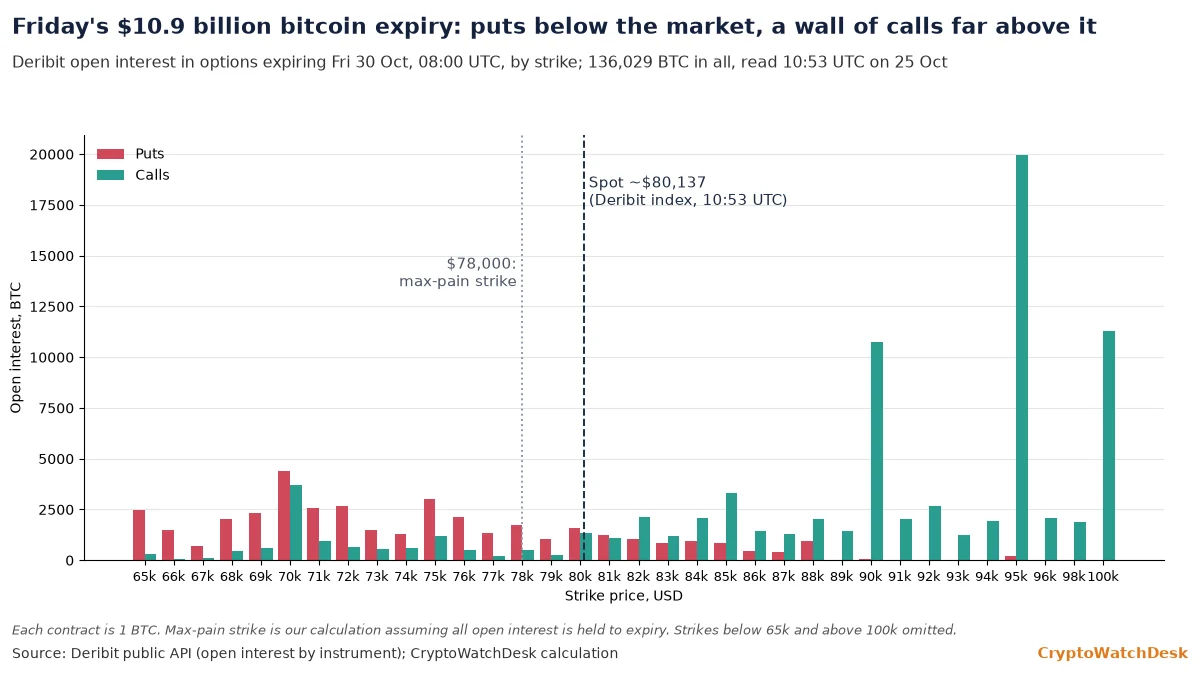
- Deribit shows 136,029 BTC of options expiring on Friday 30 Oct at 08:00 UTC (09:00 CET), about $10.9 billion and 35% of all its bitcoin option open interest. The biggest strike is $95,000, almost all calls.
Bitcoin has tested $80,000 for a second day. Next week, the central banks get a say.
The largest cryptocurrency traded near $80,166 on Kraken at 10:59 UTC (11:59 CET), down 0.75% from the UTC-day open of $80,772.0. It printed exactly $80,000.0 in the 09:15 UTC bar before steadying.
That follows Saturday’s slide to $79,120.8, its lowest since 18 Sep, which we covered in Saturday’s slide below $80,000. The week ran from a Monday open of $82,001.7 to a Wednesday high of $84,840.0, then gave it all back from Thursday.
Ether fell 1.39% since midnight UTC to $2,322.84. Solana lost 1.58%, to $100.62, and XRP 0.55%, to $1.2906.
Fund flows were steadier than the chart. US spot bitcoin funds took in a net $301.2 million in the week to 23 Oct, despite two days of outflows at the end, according to our ETF Desk.
Derivatives are calm. Deribit’s volatility index, DVOL, read 38.8 at 10:59 UTC, which implies a one-standard-deviation move of about 2.0% a day.
Perpetual funding was 0.0038% per eight hours on Deribit and 0.01% on OKX’s current period at 10:58 UTC. Put simply, funding is the fee holders of perpetual futures pay each other to keep the contract near spot, and at these levels nobody is paying much to be long.
The bitcoin week ahead, day by day (UTC / CET)
Europe moved its clocks back on Sunday, and the US does not follow until 1 Nov. For one week, US data land at 12:30 UTC, which is 13:30 in Paris, Zurich or Berlin, an hour earlier than European readers are used to.
- Tue 27 Oct: the Federal Open Market Committee begins its two-day meeting, per the Fed’s October calendar. Franklin Templeton’s filing for its two ETFs that turn stock dividends into bitcoin, FBEQ and FIBT, takes effect; no first trading date has been announced. See Franklin’s two dividend-to-bitcoin ETFs.
- Wed 28 Oct: Strategy holds its special meeting at 14:00 UTC (15:00 CET), a webcast vote on amending its four preferred stocks, STRF, STRC, STRK and STRD, to pay daily dividends, per its 5 Oct proxy statement. The FOMC statement follows at 18:00 UTC (19:00 CET), and Chair Kevin Warsh’s press conference at 18:30 UTC (19:30 CET).
- Thu 29 Oct: the Bureau of Economic Analysis publishes its advance estimate of third-quarter GDP and September personal income and outlays, which include the PCE price index, both at 12:30 UTC (13:30 CET), per its schedule. The ECB announces its decision at the end of a two-day meeting, with a press conference, per the Bundesbank’s calendar; its usual decision time is 14:15 CET (13:15 UTC). The Bank of Japan begins its two-day meeting. After the US close, Strategy and Coinbase report third-quarter results. Both have their calls at 21:00 UTC (22:00 CET): Strategy’s video webinar and Coinbase’s Q&A on X. Late that evening, bitcoin’s next difficulty retarget is due at block 973,728, which mempool.space estimates for about 21:00 UTC, with a rise of about 4.9%. That estimate moves with every block.
- Fri 30 Oct: Deribit’s monthly options expire at 08:00 UTC (09:00 CET). Eurostat publishes its preliminary flash estimate of euro-area GDP for the third quarter, per its release calendar. The Bank of Japan announces its decision and its quarterly Outlook Report, per its schedule; it does not set a fixed time. Coinbase converts European retail users’ USDT and 13 other stablecoins that are not MiCA-compliant, mostly into USDC; see Coinbase’s EEA stablecoin conversion.
Monday is clear on our list. We are not quoting consensus forecasts for GDP, PCE or the three rate decisions, because published ones differ.
Friday’s expiry, strike by strike
Of the 136,029 BTC expiring on Friday, 87,539 are calls and 48,490 are puts, a put-to-call ratio of 0.55. At Deribit’s index price of $80,137 at 10:53 UTC, that is about $10.9 billion by our arithmetic, one contract being 1 BTC. Ether options expiring the same morning add 325,630 ETH, about $0.76 billion.
A put pays if bitcoin finishes below its strike, the price written into the contract. A call pays if it finishes above. Open interest is how many contracts are still outstanding.
The calls sit far from the market. Calls at $90,000 and above hold 58,832 BTC, two-thirds of all calls in this expiry. The single biggest strike is $95,000, with 20,149 BTC, of which 19,948 are calls.
That strike is 18.5% above Sunday’s index price.
By total size, the next strikes are $100,000 (11,287 BTC, almost all calls), $90,000 (10,771 BTC, of which 10,726 calls), $70,000 (8,116 BTC, split 4,389 puts and 3,726 calls), $75,000 (4,221 BTC, of which 3,007 puts) and $85,000 (4,157 BTC, of which 3,319 calls).
The puts spread out below. Puts at or below $80,000 hold 41,375 BTC, 85% of the puts, and 33,527 BTC of those are at $75,000 or lower.
Open interest counts contracts, not intent. A call at $95,000 could be a bet on a rally, the leftover of a spread, or a covered call sold against coins already held, and the data does not say which. What it does show is where payouts would start if bitcoin finished the month at those prices.
Our max-pain strike for the expiry is $78,000, about 2.7% below Sunday’s index price. Max pain is the strike at which option holders as a group would collect the least if every contract were held to expiry. We calculate it from Deribit’s open interest.
It is a convention, not a force.
The level to watch is $80,000, tested on Saturday and again on Sunday morning. Below it, Saturday’s low of $79,120.8 is the line, and the put stacks at $75,000 and $70,000 sit further down.
Above, the line that matters for our market mood is still $84,250, the 12 Oct high. Bitcoin traded above it briefly on Wednesday, at $84,840, but did not stay there.
A different reading
The headline size flatters Friday. The $95,000 and $100,000 calls are far from the money; if bitcoin is anywhere near today’s price on Friday morning, they expire worthless and pay nothing.
The part of the book that could matter sits within a few thousand dollars of spot, and there it is roughly balanced: between $78,000 and $82,000, puts hold 6,716 BTC and calls 5,350.
Nor is Friday a one-off: Deribit’s 25 Dec expiry already holds 133,061 BTC, almost as much. For what happens to leverage when price gaps, see what a liquidation is.
Not on the calendar
- Korea’s crypto tax: the presidential office says a fourth delay of the 22% tax on crypto gains is under review and nothing has been decided, Yonhap News TV reported on Sunday, adding that talks between the ruling party and the government could follow soon. No date has been set; see our report.
- Initia: the layer-1 chain has been halted since 23 Oct after a MoveVM bug let an attacker take about $2.7 million to Ethereum, by Initia’s account. We had seen no restart notice as of Sunday morning; see our report.
- Glamsterdam on Hoodi: the testnet run of Ethereum’s next upgrade was due on Monday at 17:42 UTC. The Ethereum Foundation postponed it on 22 Oct and has set no new date; see our report.
Just beyond the week
- Sun 1 Nov: US clocks go back an hour, and the usual six-hour gap between New York and central Europe returns.
Keep Thursday clear: US GDP, the ECB, two earnings calls and a difficulty retarget all land between 12:30 and 21:00 UTC.
As of 10:59 UTC (11:59 CET), bitcoin was trading near $80,166 on Kraken.
Related: Last week’s calendar
Related: Monday's First Print: bitcoin starts Fed week after its weakest close since 17 Sep
This article is for information only and is not investment advice.