
Key points
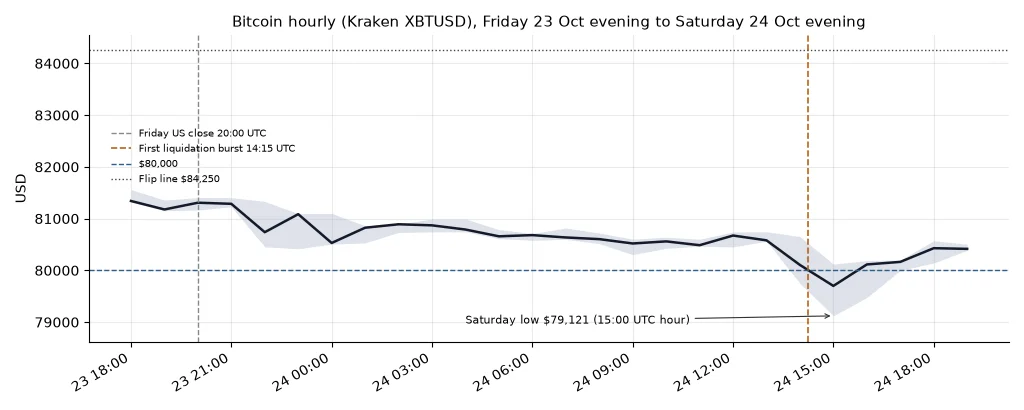
- Bitcoin fell to $79,121 on Kraken in the 15:00 UTC hour, its first trade below $80,000 since 15 Oct and its lowest since 18 Sep, then recovered to about $80,400, down 0.8% on the UTC day.
- The level that matters is still $84,250, about $3,850 above the price; bitcoin has not closed an hour above it since Wednesday.
- An hourly close back below $80,000 would put the $79,121 low in play again; only a move above $84,250 would change the picture.
The selling was brief. The damage to leveraged traders was not.
Bitcoin traded near $80,416 on Kraken at 19:54 UTC, down 0.8% from its UTC open of $81,086. Coinbase showed $80,415, with a 24-hour range of $79,107 to $81,400.
Ether fell harder, down 2.0% to about $2,337 after touching $2,280. Solana lost 1.6% to about $101 and XRP 0.5% to about $1.287.
What drove the session
The drop came in two bursts. In the four hours to 17:00 UTC, about $436 million of crypto positions were liquidated, $404 million of them longs, The Block reported, citing CoinGlass data. About $208 million went in the 15 minutes from 14:15 UTC and another $131 million from 15:15 UTC.
That was the most long liquidations in any four hours since 14 Oct, The Block said. The biggest single order was an $11.85 million ether long on Binance.
Put simply, a liquidation is a forced sale: when a leveraged bet loses more than the trader’s margin, the exchange closes it, and those sales push the price further down. what crypto liquidations are explains the mechanics.
On Kraken, the 14:00 and 15:00 UTC hours traded about 277 BTC and 379 BTC. From 01:00 to 13:00 UTC, no hour had traded more than about 71 BTC. It was a trapdoor under a crowded weekend floor: thin liquidity, a lot of leverage, and one push.
The backdrop was the Middle East.
The US State Department is reducing staff at its embassies in Jordan, Lebanon, Qatar and the United Arab Emirates, which remain open, after the director of national intelligence warned that “Iran has substantially increased efforts to target U.S. personnel,” the Associated Press reported. CoinDesk tied the slide to the evacuation reports.
That link is plausible but not proven. Reports of the embassy drawdowns were already out in the early hours of Saturday, UTC, and bitcoin barely moved until mid-afternoon.
Elsewhere, Arthur Hayes said Maelstrom had sold its directional book, taking profits on ETH, ENA and UNI.
Derivatives
Leverage came off less than the price action suggests. Deribit’s bitcoin perpetual open interest was about $851 million at 19:54 UTC, against about $860 million in Saturday’s First Print. Funding was nearly flat at 0.0009% per eight hours.
Across the market, futures open interest fell 2.2% to about $140 billion over 24 hours, The Block reported, with $815 million liquidated in that time.
Implied volatility woke up. Deribit’s DVOL index sat near 37.7 before the drop, jumped to about 38.7 by the end of the 14:00 UTC hour and peaked near 39.9 in the 15:00 hour. It was still about 38.9 in the evening.
The 30 October monthly options hold about 136,000 BTC of open interest and still lean to calls, with a put-to-call ratio of 0.56. The $95,000 call is the largest line at about 19,950 BTC; the biggest put is the $70,000 strike, at about 4,390 BTC.
The levels
The level to watch is still $84,250. The gap is now about $3,850.
Below, $80,000 is the first marker, then Saturday’s $79,121 low. Under that, the chart has little support until the 18 Sep session, which traded as low as about $76,200 on Kraken.
Above, Saturday’s early high near $81,100 is the first hurdle, then Friday evening’s $81,400, then $84,250.
The alternative read: this looks like a leverage flush, not a new wave of selling. The price was back above $80,000 within two hours, Deribit’s perpetual open interest barely fell and funding stayed positive, so the weekend’s buyers were waiting just below the round number.
For Friday’s session, see Friday’s US-close Market Read.
As of 19:54 UTC, BTC is trading near $80,400.
This article is for information only and is not investment advice.