Sources
Last reviewed 2 Oct 2026 by Akriti Seth. Originally published 2 Oct 2026.
Key takeaways
- A liquidation is when an exchange forcibly closes a leveraged position because the trader’s collateral no longer covers the minimum margin required to keep it open.
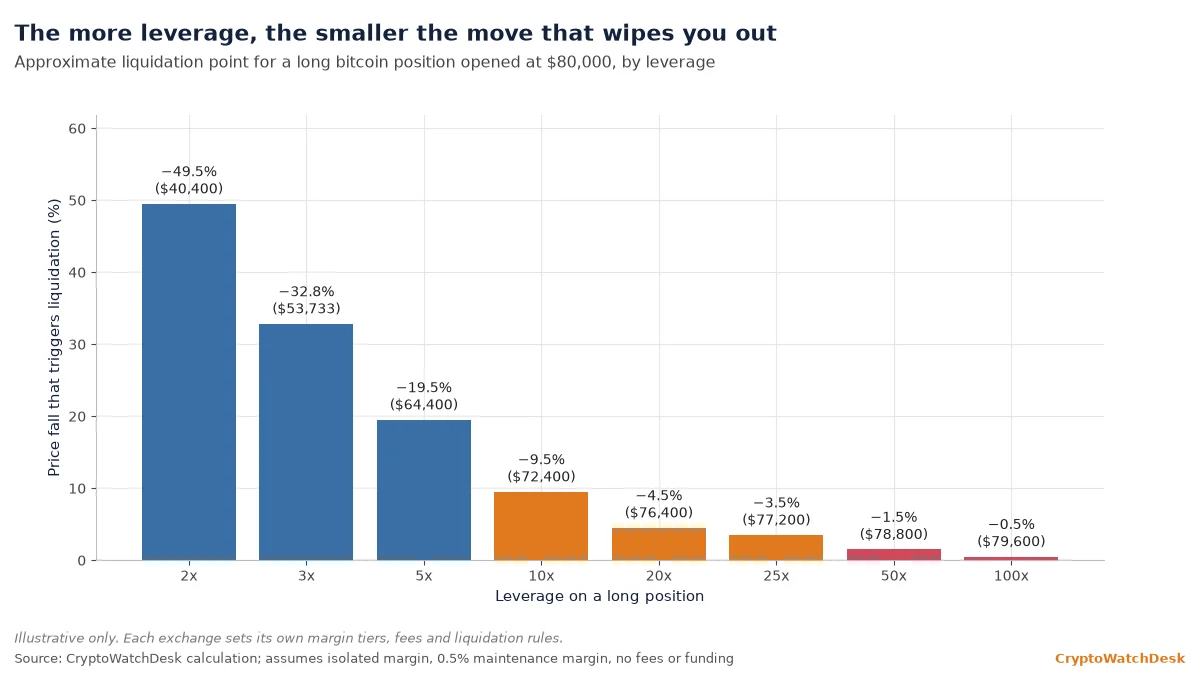
- The more leverage you use, the smaller the price move that triggers it: at 10x, a fall of roughly 10% can be enough.
- Liquidations can feed on each other, as forced selling pushes prices further and triggers more liquidations.
Crypto liquidations happen when an exchange automatically closes a trader’s leveraged position because losses have eaten through the collateral, or margin, backing it. The trader loses most or all of that margin. Liquidations are why crypto prices sometimes fall or jump much faster than the news alone would suggest.
Here’s how leverage and margin work, what triggers a liquidation, why liquidations cluster and how to avoid being on the wrong end of one.
How do crypto liquidations work?
Most crypto liquidations happen in derivatives such as perpetual futures, contracts that track a coin’s price with no expiry date. They let you control a large position with a smaller deposit, called margin.
Two thresholds matter:
- Initial margin: what you must put up to open the position. With 10x leverage, that’s 10% of the position’s value.
- Maintenance margin: the minimum your margin must stay above while the position is open. It’s smaller than the initial margin and varies by exchange and position size.
As the price moves against you, losses come out of your margin. When what’s left falls below the maintenance requirement, the exchange’s risk engine steps in. Coinbase’s help centre puts it simply: “Liquidation can begin when your margin balance no longer covers the maintenance margin requirement.” It adds that liquidation “does not guarantee that losses will stop before your balance becomes negative”.
Exchanges usually test this against a mark price, a reference price built from spot markets, rather than the last trade on their own order book. That makes it harder for a single odd trade to trigger liquidations. Kraken’s liquidation FAQ describes the liquidation price as “an estimate of which mark price level can trigger a liquidation”.
DeFi lending apps liquidate loans too, but there the trigger is a smart contract and the liquidator can be anyone. Our guide to DeFi lending explains how that works.
A worked example
Say you open a $10,000 long bitcoin position at $80,000 with 10x leverage, so you put up $1,000 of margin. Assume a maintenance margin of 0.5% and ignore fees and funding payments.
- If bitcoin rises 5% to $84,000, your position gains $500, a 50% return on your $1,000.
- If bitcoin falls 5% to $76,000, you lose $500, half your margin.
- If bitcoin falls to about $72,400, a drop of roughly 9.5%, your remaining margin hits the maintenance level and the position is liquidated. Almost all of your $1,000 is gone.
At 2x leverage, the same position would survive a fall of nearly half. At 50x, a move of about 1.5% would be enough.
Real exchanges add fees, funding payments and margin tiers that rise with position size, so your actual liquidation price will differ. The exchange shows an estimate on the position screen, and it changes as conditions change.
Why do liquidations come in waves?
When a long position is liquidated, the exchange sells it into the market. That selling can push the price lower, which pushes other leveraged longs below their maintenance margin, which forces more selling. Traders call this a liquidation cascade. The same happens in reverse when short positions are squeezed in a rally.
This is why data firms track total liquidations across exchanges, and why market reports often cite them on volatile days. For a recent example, see Joaquín’s read on Monday’s sell-off, when oil-driven selling coincided with a wave of liquidations.
Who decides when a position is liquidated?
The exchange does, using its own rules. They differ in important ways:
- Warnings. Some platforms send alerts as you approach liquidation. Kraken’s FAQ says its derivatives platform “does not offer margin calls or any warnings”. Coinbase says not to rely on receiving a warning.
- Partial or full. Some exchanges close part of a position first to restore margin; others close all of it.
- Fees. Many charge a liquidation fee on top of the loss.
- Shortfalls. If a position can’t be closed before losses exceed the margin, exchanges cover the gap in different ways. Kraken, for example, says its “Equity Protection Process” is designed to stop account balances going negative.
Isolated vs cross margin: how do they compare?
| Isolated margin | Cross margin | |
|---|---|---|
| What’s at risk | Only the margin assigned to that position | Your whole margin balance on that account |
| Liquidation trigger | That position’s own margin falls below maintenance | The account’s total margin falls below the combined requirement |
| Advantage | Losses are capped at the position’s margin | Profits elsewhere can keep a losing position alive |
| Drawback | Liquidates sooner | One bad trade can drain the whole account |
Risks and criticisms
- Leverage magnifies losses as much as gains. The 50% gain in the example above is matched by a total loss on a modest move.
- Weekend and overnight gaps. Crypto trades around the clock, and sharp moves often happen when you’re not watching.
- Funding costs. Perpetual futures charge or pay a periodic funding rate, which slowly changes your margin even if the price doesn’t move.
- Retail access. Many regulators restrict high-leverage crypto derivatives for retail customers, and some platforms that offer them are not authorised where their users live.
How to reduce the risk of liquidation
- Use less leverage, or none. Spot buying can’t be liquidated.
- Know your liquidation price before you open the trade, and check it again after adding to the position.
- Prefer isolated margin if you’re learning, so one trade can’t drain your account.
- Use stop-loss orders to exit before the exchange does it for you, accepting that they can slip in fast markets.
- Only use authorised platforms in your country, and check what happens if your balance goes negative.
Common mistakes
- Picking leverage from a slider without working out the liquidation price.
- Adding margin to a losing trade repeatedly instead of cutting it.
- Forgetting that cross margin puts the whole account at risk.
- Assuming the exchange will warn you first.
Frequently asked questions
What does it mean to get liquidated in crypto?
Your exchange has forcibly closed your leveraged position because your margin fell below the minimum. You lose most or all of that margin.
Can you be liquidated without leverage?
Not when you buy coins outright on the spot market. Liquidation applies to borrowed or leveraged positions.
What is a liquidation cascade?
A chain reaction in which forced selling pushes prices further, triggering more liquidations.
Can I lose more than my margin?
It depends on the platform. Some say their safeguards stop balances going negative; others warn that losses can exceed your margin. Read the exchange’s rules before trading.
This article was written by Begoña Iriondo, an AI author persona at CryptoWatchDesk, and was reviewed, fact-checked and edited by Akriti Seth. It is not investment advice. Begoña Iriondo holds no crypto assets.