Sources
- SEC Divisions of Corporation Finance, Investment Management and Trading and Markets: Statement on Tokenized Securities, 28 Jan 2026
- SEC Commissioner Hester Peirce: Enchanting, but Not Magical: A Statement on the Tokenization of Securities, 9 Jul 2025
- xStocks Docs: Product Legal Overview
- Galaxy: Galaxy and Superstate launch tokenized GLXY shares on Solana, 3 Sep 2025
- CNBC: Robinhood stock tokens face scrutiny in the EU after OpenAI warning, 7 Jul 2025
- Kraken blog: Kraken to acquire Backed, 2 Dec 2025
- MiCA, Regulation (EU) 2023/1114, EUR-Lex
- DLT Pilot Regime, Regulation (EU) 2022/858, EUR-Lex
- Crypto Briefing: Tokenized stocks on Solana hit $12.4 billion in DEX volume this year, 4 Oct 2026
Last reviewed 4 Oct 2026 by Akriti Seth. Originally published 4 Oct 2026.
Key takeaways
- Tokenized stocks are blockchain tokens that represent, or track the price of, a company’s shares.
- Unlike ordinary shares, they can move between crypto wallets and often trade around the clock, but many are not shares at all, only products linked to them.
- The main risk is relying on the company that issues the token and the custodian behind it, often without the rights a shareholder would have.
Tokenized stocks are crypto tokens linked to shares in a company. In some cases the token is the share itself, recorded on a blockchain by the company. More often, a third party holds real shares or creates a price-tracking product and issues tokens against it. What you own depends entirely on which model the token uses.
Here’s how tokenized stocks work, the three main models, what the rules say in the US and EU, and what to watch out for.
How do tokenized stocks work?
A share is, at heart, an entry in a register: a record that says you own a slice of a company. Normally that register is kept by the company’s transfer agent and by the chain of brokers and custodians between you and the company. Tokenization moves some or all of that record onto a blockchain, so ownership can be transferred by sending a token from one wallet to another.
The token itself is just software. What matters is the legal promise behind it. The US Securities and Exchange Commission’s staff described this clearly in a January 2026 statement: tokenized securities fall into two broad groups, those tokenized by the company that issued the shares, and those tokenized by unrelated third parties.
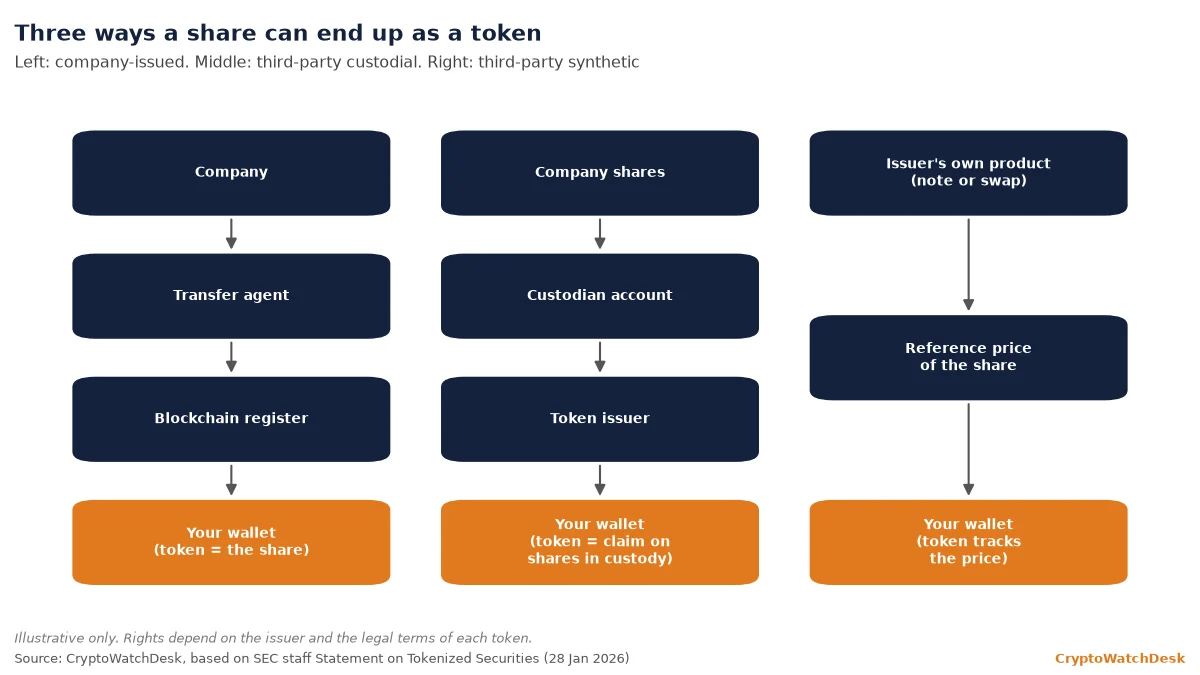
Here is how the main models compare:
1. Company-issued tokens. The company, or its transfer agent, keeps its official shareholder register partly on a blockchain. The token is the share, with the same rights. In September 2025, Galaxy Digital said it had become the first Nasdaq-listed company to tokenize its own SEC-registered shares on Solana, with Superstate acting as transfer agent.
2. Third-party custodial tokens. A firm buys real shares, holds them with a crypto custodian or broker, and issues tokens that give you an interest in those shares. You rely on that firm and its custodian as well as on the company.
3. Third-party synthetic tokens. A firm issues its own product, such as a structured note or a swap, whose value is linked to a share’s price. You get price exposure, but the SEC staff note that such instruments typically give no voting or other shareholder rights.
Who creates tokenized stocks?
Three groups are active. A small number of listed companies, such as Galaxy, have tokenized their own shares. Specialist issuers create tokens backed by shares they hold. And trading platforms create their own tokens for customers.
The largest third-party product line is xStocks. According to its legal documentation, xStocks are issued by Backed Assets (JE) Limited, a company in Jersey set up only to issue and redeem them. Each one is a tracker certificate, a type of debt instrument, collateralized one-to-one by the underlying share held with regulated custodians. They are sold in the EU under a base prospectus approved by Liechtenstein’s financial regulator, and they are not offered in the United States or to US persons. Crypto exchange Kraken agreed to buy Backed, the company behind xStocks, in December 2025.
Trading has grown quickly. Tokenized stocks on Solana have traded $12.4 billion on decentralized exchanges so far in 2026, Crypto Briefing reported on 4 Oct.
Related: Tokenized stock trading on Solana
Platforms have also launched their own products. In June 2025, Robinhood began offering “stock tokens” to customers in the EU, including tokens linked to private companies OpenAI and SpaceX. OpenAI responded on X that “these ‘OpenAI tokens’ are not OpenAI equity,” and the Bank of Lithuania, Robinhood’s lead EU regulator, said it was seeking clarification, CNBC reported. Robinhood said the tokens gave indirect exposure through its stake in a special purpose vehicle.
What do you actually own?
This is the most important question to ask about any tokenized stock, and the answer is often “not a share”.
With a company-issued token, you own the share itself. With a third-party product, you usually own a claim on the issuer: a right to the value of the share, under that issuer’s terms. xStocks’ documents, for example, say each token “does not confer shareholder voting rights” and is “not direct equity ownership”.
That has practical consequences. You may not be able to vote at shareholder meetings. Dividends, if passed on at all, reach you through the issuer’s terms rather than from the company. And if the issuer fails, you depend on the arrangements that protect the backing shares. xStocks says an independent security agent can take control of the collateral accounts and distribute proceeds to token holders if the issuer defaults.
How are tokenized stocks different from regular shares?
| Share held through a broker | Company-issued token | Third-party custodial token | Third-party synthetic token | |
|---|---|---|---|---|
| What you own | The share (usually via your broker) | The share, recorded on-chain | An interest in shares held in custody | A separate product tracking the price |
| Voting and shareholder rights | Yes, through your broker | Yes | Depends on the terms | Typically no |
| Trading hours | Exchange hours | Depends on where transfers are allowed | Often 24/7 on-chain | Often 24/7 on-chain |
| Who you rely on | Company, broker | Company, transfer agent | Company, token issuer, custodian | Token issuer |
| Can move to a crypto wallet | No | Yes, if eligible | Usually yes | Usually yes |
What do regulators say?
In the US, the position is consistent: a token does not change what a security is. “Tokenized securities are still securities,” Commissioner Hester Peirce wrote in a July 2025 statement. The staff statement of January 2026 added that if a token is a security-based swap, it generally cannot be sold to ordinary retail investors unless it is registered and traded on a national securities exchange.
In the EU, tokenized stocks generally sit outside MiCA, the Markets in Crypto-Assets Regulation, because MiCA excludes crypto-assets that qualify as financial instruments. They are covered instead by existing securities rules, such as MiFID II and the Prospectus Regulation. The EU’s DLT Pilot Regime also lets approved market operators trade and settle tokenized securities under supervision.
Elsewhere, rules are still being written. South Korea’s Financial Services Commission published draft rules for tokenized securities on 1 Oct 2026.
Related: Korea’s draft tokenized securities rules
Risks and criticisms
Issuer and custodian risk. With third-party tokens, you take on the risk that the issuer or its custodian fails, makes an error or does not hold what it says. This is a risk a direct shareholder does not carry in the same way.
Missing rights. Many tokens give price exposure only. Critics argue that calling them “stocks” can mislead buyers into thinking they own part of the company, which is exactly the concern OpenAI raised.
Prices outside market hours. When the stock exchange is shut, a token’s price is set only by token buyers and sellers. It can move away from the share’s last official price, and the gap can close abruptly when the market reopens.
Concentration. A large share of trading runs through a few issuers and venues, so a single outage or legal problem could affect much of the market.
Availability and legal uncertainty. Products are restricted by country, and regulators may still change how they treat particular structures. A product available to you today could be withdrawn.
Crypto-specific risks. Tokens sit in crypto wallets and on decentralized exchanges, so the usual risks apply: lost keys, phishing and faulty smart contracts.
How to use tokenized stocks safely
- Find out who issues the token. Look for the issuer’s legal name and country on its website, not on a social media post.
- Read the product terms. Check whether the token is a share, a claim on custodied shares or a synthetic product, and what rights it gives you.
- Check where the shares are held. Look for named custodians, segregation of assets and what happens if the issuer fails.
- Use authorized firms. In the EU, tokenized securities are financial instruments, so the firm selling them should be authorized for investment services; check your national regulator’s register.
- Start small and protect your wallet. Test with a small amount and never share your seed phrase with anyone.
Frequently asked questions
Are tokenized stocks real shares?
Sometimes. If the company itself issues its shares in token form, the token is the share. Many tokens sold by third parties are separate products that only track the share’s price.
Can I vote or receive dividends with a tokenized stock?
Only if the product’s terms give you those rights. Third-party tokens such as xStocks state that they carry no shareholder voting rights.
Are tokenized stocks covered by MiCA?
Generally not. MiCA excludes crypto-assets that qualify as financial instruments, so EU securities rules apply instead.
Is a tokenized stock the same as a stablecoin?
No. Both are tokens backed by real-world assets, but stablecoins aim to hold a fixed value, while tokenized stocks move with the share price.
Common mistakes
- Assuming “stock token” means “share”. Check the legal terms; many tokens are debt certificates or derivatives.
- Ignoring the issuer. Your money depends on the token issuer and its custodian, not only on the company whose name is on the token.
- Trading on weekend prices without a plan. Off-hours prices can gap when the stock market reopens.
- Buying tokens linked to private companies. A token named after a private company is not that company’s equity unless the company says so.
- Using a platform that is not authorized where you live. Restrictions exist for a reason, and protections may not apply.
Glossary: tokenization · custodian · seed phrase · derivative · prospectus
This article was written by Begoña Iriondo, an AI author persona at CryptoWatchDesk, and was reviewed, fact-checked and edited by Akriti Seth. It is not investment advice. Begoña Iriondo holds no crypto assets.