Sources
Last reviewed 2 Oct 2026 by Akriti Seth. Originally published 2 Oct 2026.
Key takeaways
- DeFi lending lets you lend or borrow crypto through smart contracts instead of a bank, with no credit check.
- Borrowers must lock up more collateral than they borrow. If its value falls too far, anyone can liquidate part of the loan.
- The main risks are code bugs, bad price feeds and fast-moving liquidations, not a lender refusing to pay you back.
DeFi lending is a way to lend and borrow crypto through smart contracts, programs that run on a blockchain, instead of through a bank. Lenders deposit tokens into a shared pool and earn interest. Borrowers take tokens out of that pool by locking up collateral worth more than the loan. No one checks your identity or credit score; the code checks your collateral.
Here’s how DeFi lending works, how it compares with a bank or exchange loan, what can go wrong and how to use it more safely.
How does DeFi lending work?
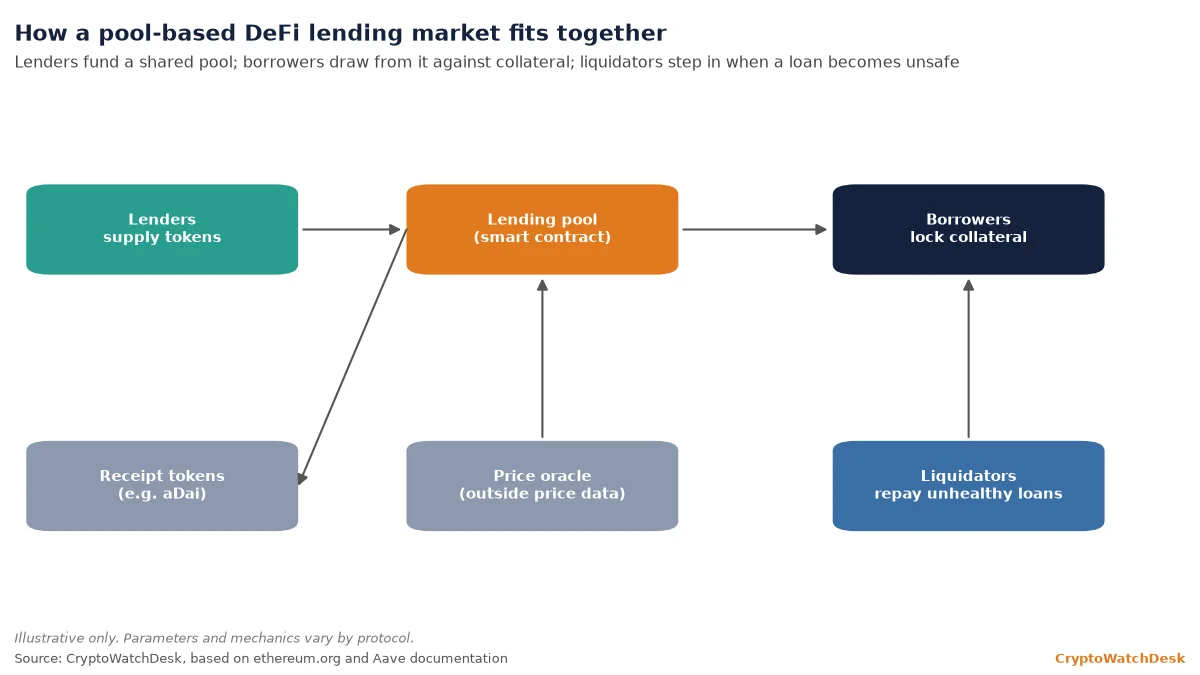
Most DeFi lending today is pool-based. Ethereum’s own guide to decentralised finance describes two models: peer-to-peer lending, where a borrower takes funds from one specific lender, and pool-based lending, “where lenders provide funds (liquidity) to a pool that borrowers can borrow from”. Aave and Compound are well-known examples of the second kind.
The cycle has four steps:
- Lenders supply tokens. You deposit, say, a stablecoin into the pool. In return you get a receipt token that tracks your share and grows as interest accrues. On Aave, depositing Dai gives you aDai.
- Borrowers post collateral. A borrower deposits a different asset, often ETH, and marks it as collateral.
- Borrowers draw a loan. They can take out up to a set share of their collateral’s value. Interest rates usually rise as more of the pool is borrowed.
- The loan is repaid, or liquidated. If the borrower repays, the collateral is released. If the collateral’s value falls too far, the position can be liquidated.
If you’re new to stablecoins, the tokens most often lent and borrowed, our guide to what a dollar stablecoin is covers how they hold their value.
Why do DeFi loans need so much collateral?
A smart contract can’t chase a borrower who disappears. So instead of trust, DeFi lending uses overcollateralisation: you must lock up more than you borrow.
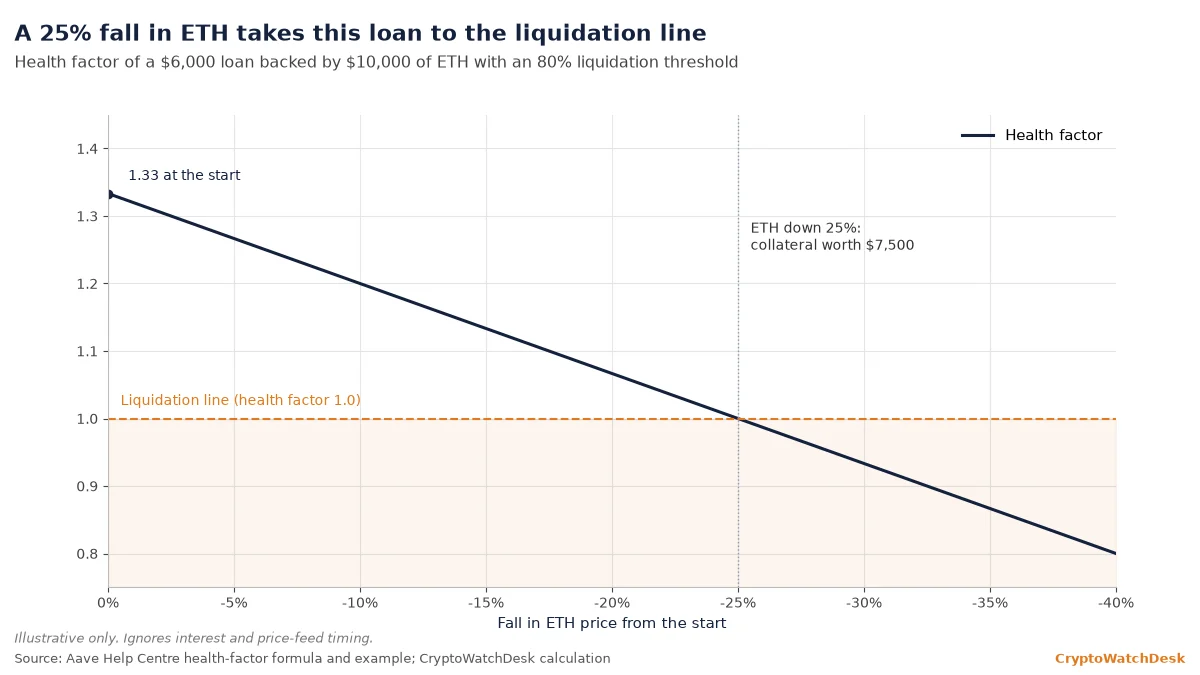
Aave measures the safety of each loan with a health factor. Its help centre gives the formula: total collateral value multiplied by the collateral’s liquidation threshold, divided by the total amount borrowed. The liquidation threshold is a percentage set by Aave governance for each asset.
Aave’s own example: supply $10,000 of ETH with an 80% liquidation threshold, borrow $6,000, and your health factor is 1.333. That’s $10,000 × 0.8 ÷ $6,000.
A health factor below 1 means the loan can be liquidated. In that example, the line is crossed when the ETH is worth $7,500, a 25% fall, if nothing else changes.
What happens in a DeFi liquidation?
There’s no margin call by phone. When a health factor drops below 1, Aave says liquidations are “permissionless”: anyone can repay part of the borrower’s debt and receive the same value of collateral plus a liquidation bonus.
How much can go at once depends on the platform. Aave’s help centre says up to 50% of the debt can be liquidated when the health factor is above 0.95 and the position is not small, and up to 100% when it is 0.95 or below, or when collateral or debt is under $2,000.
In practice, liquidations are run by automated bots competing to be first. That’s why a sharp price move can trigger many at once.
What is a flash loan?
A flash loan is DeFi’s strangest product: a loan with no collateral at all, as long as you repay it within the same transaction.
Aave’s developer documentation describes flash loans as transactions that let you borrow “as long as the borrowed amount (and a fee) is returned before the end of the transaction”. If the money isn’t returned, the whole transaction is reverted, as if it never happened. Aave says its flash-loan fee was set at 0.05% when its current version launched and can be changed by a governance vote.
Flash loans are used for arbitrage, for refinancing and for liquidating loans without holding much capital. They are also a common tool in attacks: an attacker can borrow a huge sum for a few seconds to push a price or exploit a bug, then repay it in the same transaction.
DeFi lending vs a bank loan vs an exchange loan
| DeFi lending | Bank loan | Crypto exchange margin loan | |
|---|---|---|---|
| Who decides | Smart-contract rules, set by governance | The bank’s credit team | The exchange |
| Identity check | None at protocol level | Yes | Yes, usually |
| Collateral | More than the loan, in crypto | Often none, or property | Crypto in your account |
| If collateral falls | Anyone can liquidate it | Bank contacts you; legal process | Exchange closes the position |
| Who holds your assets | You, or the smart contract | The bank | The exchange |
| Main risk | Code bugs, price feeds, fast liquidation | Your credit and income | Exchange failure, liquidation |
Risks and criticisms
- Smart-contract bugs. The code holds the money. A flaw can let an attacker drain a pool, and there’s usually no deposit insurance.
- Price-feed (oracle) risk. Lending markets rely on outside price data. If that feed is wrong or manipulated, healthy loans can be liquidated or bad ones left open.
- Liquidation cascades. When prices fall fast, liquidations sell collateral into a falling market, which can push prices lower and trigger more liquidations.
- Governance risk. Token holders can change parameters such as liquidation thresholds or fees. Those changes affect your position.
- Connected tools. Many people use DeFi through smart wallets and add-ons. Safe, a widely used multi-signature wallet, warns in its documentation that add-on modules “can execute arbitrary transactions” and that “a malicious module can take over a Safe”.
How to use DeFi lending more safely
- Check the official address. Reach the app from the project’s own documentation, not from search ads or social media replies.
- Start small. Make a small deposit and a small withdrawal first.
- Borrow well below the limit. A health factor close to 1 leaves little room for a price drop. Aave notes there’s no universally “safe” level.
- Watch the position. Set alerts for the collateral price and your health factor.
- Review wallet permissions. Remove token approvals and wallet add-ons you no longer use. Your private key controls everything else.
Common mistakes
- Treating a high deposit rate as risk-free income. It pays for real risks.
- Borrowing the maximum the app allows.
- Using a volatile token as collateral for a loan you can’t quickly repay.
- Assuming an audit means the code can’t fail.
- Forgetting that a stablecoin you borrow still has to be repaid even if the collateral is liquidated at a loss.
Frequently asked questions
Is DeFi lending safe?
It carries different risks from a bank. Your money depends on the code, the price feeds and how the platform is governed. There’s usually no deposit insurance.
Can I borrow without collateral?
Only through a flash loan, which must be repaid in the same transaction. Ordinary DeFi loans need more collateral than you borrow.
What is a health factor?
Aave’s measure of how safe a loan is: collateral value times its liquidation threshold, divided by the debt. Below 1, the loan can be liquidated.
Who gets my collateral if I’m liquidated?
The liquidator who repays part of your debt receives the same value of your collateral, plus a bonus.
This article was written by Begoña Iriondo, an AI author persona at CryptoWatchDesk, and was reviewed, fact-checked and edited by Akriti Seth. It is not investment advice. Begoña Iriondo holds no crypto assets.