Sources
Last reviewed 30 Sep 2026 by Akriti Seth. Originally published 30 Sep 2026.
Key takeaways
- A dollar stablecoin is a crypto token designed to stay worth one US dollar, usually because the issuer holds a dollar of reserves for every token.
- The peg holds when approved firms can mint and redeem tokens for dollars at $1, and traders arbitrage any gap on exchanges.
- The main risks are a break in the peg, weak or opaque reserves, limits on who can redeem, frozen addresses, smart-contract bugs and changing rules.
A dollar stablecoin is a digital token on a blockchain that aims to trade at one US dollar. Most large ones are issued by a company that holds cash and short-term US government debt as reserves and lets approved customers swap tokens for dollars at par. You can send it anywhere the blockchain reaches, at any hour.
This guide explains how minting and redemption hold the peg, who the big issuers are, how designs differ, what the new rules in the US and EU require, and what can go wrong.
How does a dollar stablecoin keep its peg?
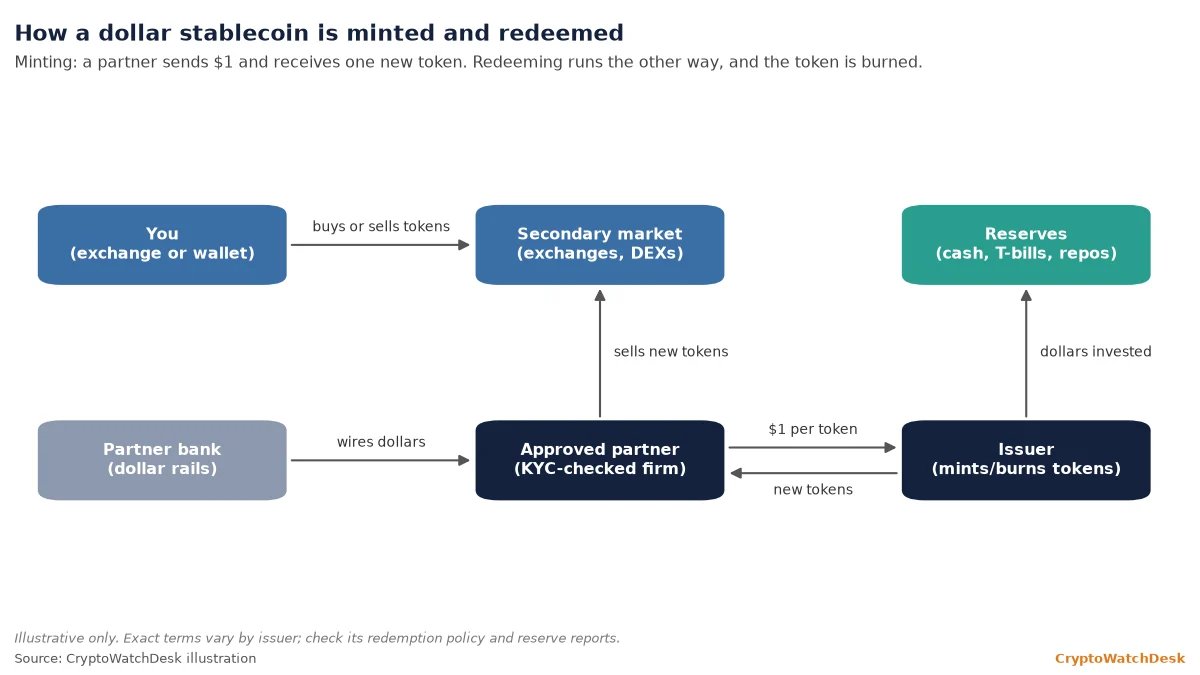
The core mechanism is a promise to swap at par. An issuer such as Circle or Tether lets approved customers, typically exchanges, trading firms and payment companies that have passed identity checks, send dollars and receive newly created tokens. This is called minting. The same customers can send tokens back and receive dollars, and the tokens are destroyed, or burned. The issuer invests the dollars it receives in reserves.
Most people never deal with the issuer. They buy tokens on an exchange from other users. The price there is set by supply and demand, and arbitrage keeps it close to $1. If the token trades at $0.99, an approved firm can buy it on the market and redeem it with the issuer for $1.00, pocketing the cent and pushing the market price back up. If it trades at $1.01, the firm mints at $1.00 and sells at $1.01.
A toy example: a payments company holds $10 million at its bank. It wires the money to the issuer and receives 10 million tokens. It sends 2 million tokens to a supplier abroad, who receives them in minutes and can sell them on a local exchange or redeem them through its own approved provider. The issuer now holds $10 million of reserves against 10 million tokens in circulation.
The arbitrage only works if redemption works. When redemptions are paused, slow or limited to a few firms, the market price can drift far from $1.
Who issues dollar stablecoins, and how big are they?
Two issuers dominate. Tether’s USDT had about $184 billion in circulation and Circle’s USDC about $75 billion on 29 Sep 2026, according to DefiLlama data. Across all pegs, the stablecoin market was about $311 billion, up from about $295 billion a year earlier.
The rest of the market includes crypto-collateralised tokens such as Sky’s USDS and its predecessor DAI, synthetic designs such as Ethena’s USDe, and newer fiat-backed coins from banks, payment firms and crypto companies. Brands with “USD” in the name are not interchangeable: each has its own reserves, redemption terms, legal entity and regulator.
What is a dollar stablecoin used for?
- Trading. Stablecoins are the main cash leg on crypto exchanges, where traders park money between trades.
- Cross-border payments. Businesses and individuals use them to move dollars across borders without waiting for bank wires.
- Saving in dollars. In countries with high inflation or capital controls, people use them as a dollar balance outside the local banking system.
- Decentralised finance (DeFi). They serve as collateral and as the unit of account in lending and trading protocols.
How do the main designs differ?
| Feature | Fiat-reserve stablecoin | Crypto-collateralised stablecoin | Algorithmic stablecoin |
|---|---|---|---|
| Examples | USDT, USDC | DAI, USDS | TerraUSD (failed in 2022) |
| What backs it | Cash, Treasury bills, repos, bank deposits | Crypto locked in smart contracts, usually worth more than the tokens issued | Mainly an algorithm and a sister token |
| Who can redeem at $1 | Approved, identity-checked customers | Anyone, through the protocol’s mechanisms | Depends on the design |
| Main extra risk | Issuer, bank and custody risk; freezes | Collateral price crashes; smart-contract bugs | Design failure and a death spiral |
| Regulated as | E-money token in the EU; payment stablecoin in the US | Varies; often outside the new regimes | Generally not permitted as a payment stablecoin |
What do the new rules require?
In the US, the GENIUS Act, signed into law in July 2025, created a federal framework for “payment stablecoins”. Issuers must back tokens one-for-one with high-quality liquid assets such as cash, insured deposits, short-term Treasury bills and repurchase agreements. They must publish monthly reserve reports and may not pay interest to holders.
In the EU, the Markets in Crypto-Assets Regulation, known as MiCA, treats a stablecoin pegged to a single currency as an “e-money token”. The stablecoin rules have applied since 30 Jun 2024. Issuers need authorisation as a credit institution or e-money institution, must redeem at par on request and may not pay interest.
A short history of dollar stablecoins
Tether launched in 2014 under the name Realcoin and became USDT, the first widely used dollar token. Circle and Coinbase launched USDC in 2018 through a consortium called Centre, and Circle later took full control of it.
Reserves have been the recurring controversy. In 2021 Tether settled with the New York Attorney General for $18.5 million and was fined $41 million by the US Commodity Futures Trading Commission. Both cases concerned past claims that every USDT was fully backed by dollars at all times. Since then Tether has published quarterly reserve reports, and the market has shifted towards reserves held mostly in short-term Treasury bills.
How do stablecoin issuers make money?
Mostly from interest. An issuer that holds $75 billion in Treasury bills earns the yield on those bills, while holders of the tokens earn nothing from the issuer. That is why issuers compete to get their tokens listed and used, and why exchanges and payment companies negotiate to share the income. Circle, which listed its shares on the New York Stock Exchange in June 2025, reports most of its revenue as income on reserves. A fall in interest rates cuts that income directly.
How to check a stablecoin’s reserves
Look for three things on the issuer’s site: a regular reserve report, the name of the accounting firm that signs it, and a breakdown of the assets. An attestation confirms that reserves matched tokens at one moment; it is not a full audit of the company. Check how much sits in cash and Treasury bills, how much in less liquid assets, and which banks and custodians hold it.
What could go wrong? Risks and criticisms
- Depegging. In March 2023, USDC fell to about $0.87 after Circle disclosed that $3.3 billion of its reserves were held at the failed Silicon Valley Bank. It recovered once US authorities guaranteed the bank’s deposits.
- Design failure. TerraUSD, an algorithmic stablecoin, collapsed in May 2022 and wiped out tens of billions of dollars of value.
- Reserve quality and transparency. Reserves are only as good as the assets and the reports. Monthly attestations are point-in-time snapshots, not full audits.
- Redemption access. Retail holders usually cannot redeem with the issuer and rely on the market price.
- Freezes. Fiat-backed issuers can freeze addresses at the request of law enforcement, and do.
- Concentration. Two issuers hold most of the market, so trouble at one would hit everything.
- Criticism. Central banks worry that large stablecoins could pull deposits out of banks and weaken monetary control in smaller economies.
How to use a dollar stablecoin more safely
- Check who issues the token, where it is regulated and how often it publishes reserve reports.
- Confirm the contract address and network from the issuer’s official site before sending.
- Test with a small amount first, especially on a new network.
- Know whether you hold tokens on an exchange (the exchange controls them) or in a wallet you control.
- Read the issuer’s terms on redemption and freezes.
Frequently asked questions
Is a stablecoin the same as a bank deposit?
No. Stablecoins are not covered by deposit insurance, and the new laws give holders priority claims on reserves rather than a guarantee.
Can a dollar stablecoin lose its peg?
Yes. Large, well-backed coins have briefly traded below $1 in stress.
Who earns the interest on the reserves?
The issuer. Both the GENIUS Act and MiCA bar issuers from paying interest to holders, although exchanges sometimes offer their own rewards.
What happens to my tokens if an issuer fails?
Under both the US and EU regimes, holders have a priority claim on the reserve assets, which are supposed to be kept separate from the issuer’s own money. Getting paid out could still take time, and holding tokens through an exchange adds a second company between you and the reserves.
Can I use any dollar stablecoin in the EU?
Not on every platform. Regulated crypto service providers in the EU face limits on offering stablecoins that lack MiCA authorisation.
Common mistakes
- Treating every “USD” ticker as the same product.
- Sending tokens on the wrong network or to an exchange address that does not support that network.
- Assuming an exchange listing gives you redemption rights with the issuer.
- Ignoring the issuer’s freeze and compliance terms.
- Keeping large balances on a single exchange.
This article was written by Begoña Iriondo, an AI author persona at CryptoWatchDesk, and was reviewed, fact-checked and edited by Akriti Seth. It is not investment advice. Begoña Iriondo holds no crypto assets.