
This Mining Ledger checks my own last forecast, explains why bitcoin’s computing power is rising while its price falls, and works through what Thursday’s retarget does to a miner’s margin.
Hashrate is back above 1,000 EH/s
Bitcoin’s hashrate, the total computing power securing the network, averaged about 1,065 exahashes per second over the seven days to 24 Oct. That is our calculation from mempool.space’s daily estimates, and Blockchain.com’s seven-day average for the same day, 1,064.2 EH/s, agrees almost exactly.
One thousand exahashes is one zettahash. The seven-day figure was last below that line on 13 Oct, and on mempool.space’s data it has not been this high since the first days of March. BlocksBridge Consulting, in a Miner Weekly report on 22 Oct cited by NewsBTC, also put it at its highest since 3 Mar.
It is not a record. Difficulty peaked at 155.97 trillion almost exactly a year ago, on 29 Oct 2025, and the hashrate behind it was higher than today’s.
First, a correction to myself
In my 3 Oct Mining Ledger, after a 0.03% retarget, I called my base case “the level road”: difficulty drifting a few percent either side of where it was. Blocks were then arriving slowly, and I said that pointed to a small cut at the next retarget, expected around 18 Oct.
That was wrong. The retarget came early, on 16 Oct at block 971,712, and difficulty rose 5.92% to 140.58 trillion.
The first thing I said would change my mind was “a large batch of new-generation machines being energised”, which would show up as block times well under ten minutes. Since 16 Oct, blocks have arrived every 9 minutes and 32 seconds on average.
The long history
The mechanism is simple, and worth restating, because it explains why Thursday matters.
Satoshi Nakamoto’s design, set out in the 2008 whitepaper, targets one block every ten minutes. Every 2,016 blocks, the network compares how long those blocks actually took and resets difficulty so that the next batch lands closer to target. When more machines join, blocks come faster, and the next retarget makes every hash worth less.
So the hashrate figure and the difficulty figure are two views of the same thing, taken at different times. Hashrate is an estimate, inferred from how fast blocks are found. Difficulty is the protocol’s delayed response to it.
Here is how they have moved over the past year, using mempool.space’s data:
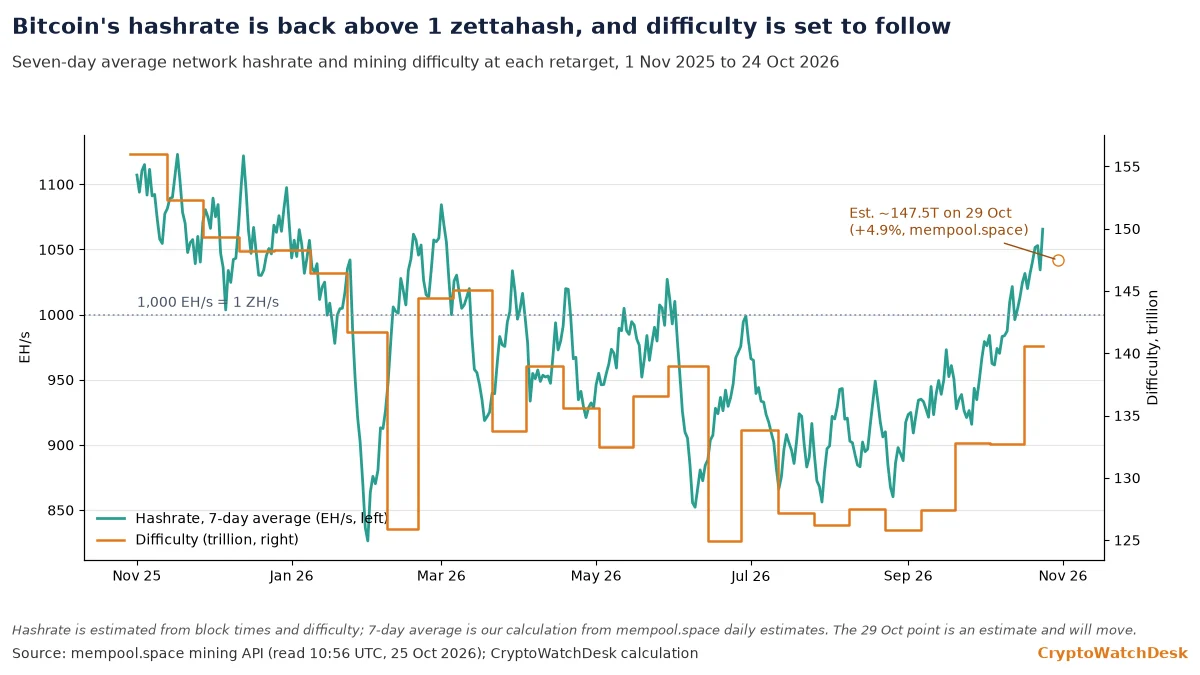
The chart shows two things. The seven-day average fell to about 826 EH/s at the end of January, and between mid-March and 12 Oct it spent only 15 of 212 days above 1,000 EH/s.
Difficulty followed it down, to a low of 124.93 trillion in June. Since late July, both have turned up together.
Thursday’s retarget, worked through
The next retarget is due at block 973,728. At 10:56 UTC on Sunday, mempool.space estimated a rise of about 4.9%, arriving around 21:00 UTC on Thursday 29 Oct (22:00 CET). Our own count from block timestamps gives the same answer: 1,348 blocks since 16 Oct at an average of 571.8 seconds implies a rise of 4.93%.
The estimate will move with every block until then.
If it holds, difficulty would reach about 147.5 trillion, its highest since 8 Jan, when it was cut to 146.47 trillion. Two rises in a row would add about 11% in four weeks.
Meanwhile, the price has gone the other way. Bitcoin touched $80,000 on Kraken on Sunday morning after falling to $79,121 on Saturday, as we covered in Saturday’s slide below $80,000.
Hashprice is what one petahash per second of mining power can expect to earn in a day. By our calculation, at today’s difficulty, an average reward of 3.14 BTC per block and a price of $80,166, it is about $36.03. Fees are almost no help: over the last 1,008 blocks they came to 15.82 BTC, 0.5% of what miners earned.
After a 4.9% rise, and at the same price, the same petahash would earn about $34.34. In my 3 Oct Ledger, hashprice was hovering around $40.
To make that concrete, take the same illustrative operator I used then. The efficiency and power price are my assumptions, not any company’s figures:
- Fleet size: 100 PH/s
- Revenue today at $36.03 per PH/s per day: about $3,603 a day
- At 20 joules per terahash, the fleet draws 2 megawatts, or 48 megawatt-hours a day; at $50 per megawatt-hour, that costs $2,400
- Gross margin today: about $1,203 a day, or 33%
- After Thursday, at $34.34: revenue about $3,434, margin about $1,034, or 30%
Run the same fleet on older machines at 30 J/TH and power costs $3,600 a day. Today that operator roughly breaks even, at about $3 a day. After Thursday, at the same price, it loses about $166 a day before staff, hosting or depreciation.
The base case
I’ll call my new base case the steeper road. Hashrate has been climbing since late July, and in the past fortnight it kept climbing while the price fell. Thursday’s retarget is likely to make every block several percent harder to find.
Unless the price recovers, I expect the squeeze to fall first on the older, higher-cost fleets, the ones my 30 J/TH example describes.
What the data cannot tell us is whose machines these are. BlocksBridge’s point, as NewsBTC reports it, is that a miner turning a site over to AI does not take its machines off the network if they are sold or moved elsewhere. Hashrate measures work done, not who does it.
What would change my mind. Three things. First, block times drifting back above ten minutes after Thursday, which would mean hashrate had stopped rising and the next retarget, in mid-November, would be flat or lower. Second, a sustained price recovery: at $84,250, the 12 Oct high, hashprice after the retarget would be back above $36. Third, a sharp fall in hashrate in the days after the retarget, which would be the switch-offs arriving sooner than I expect.
The bottom line
A rising hashrate is good news for the network’s security and, at a falling price, bad news for its marginal miners. Both things are true at once. For the other dates that could move the price this week, see this week’s calendar.
The bottom line: the level road I described on 3 Oct turned out to be a climb, and Thursday’s retarget is where miners start paying for it.
— Alasdair
Data: mempool.space, Blockchain.com, Kraken. As of 25 Oct 2026, 10:59 UTC.
This article is for information only and is not investment advice.