This month’s Mining Ledger looks at why a near-zero difficulty change is itself informative, and how long the calm is likely to last.
Bitcoin difficulty barely moved
Bitcoin difficulty, the setting that decides how hard it is to find a block, fell by just 0.03% to 132.72 trillion at block 969,696 on Saturday, 3 Oct, according to Bitcoin.com News and ASIC.tools. It was the smallest of the year’s 19 adjustments.
The quiet number arrives after a good month. Miners earned about $1.12 billion in September, according to Newhedge data cited by Bitcoin.com, their best month since January’s $1.15 billion.
The long history
It is worth starting at the beginning, because the mechanism is older than most of the machines now running it. Satoshi Nakamoto’s design, described in the 2008 whitepaper, aims for one block roughly every ten minutes. Every 2,016 blocks, about two weeks, the network compares how long those blocks actually took and adjusts difficulty up or down so the next batch lands closer to target. If more machines join, blocks come faster and difficulty rises; if machines switch off, it falls.
So a 0.03% change says something precise: over the past fortnight, the network’s total computing power, its hashrate, was almost exactly what the previous difficulty assumed. Neither a rush of new machines nor a wave of shutdowns.
For scale, consider the other extreme. In July 2021, after China’s crackdown forced miners to unplug and relocate, difficulty fell by about 28% in a single retarget, the largest cut in the network’s history. A move of three hundredths of a percent sits at the opposite end of that spectrum: the system doing its job with almost nothing to correct.
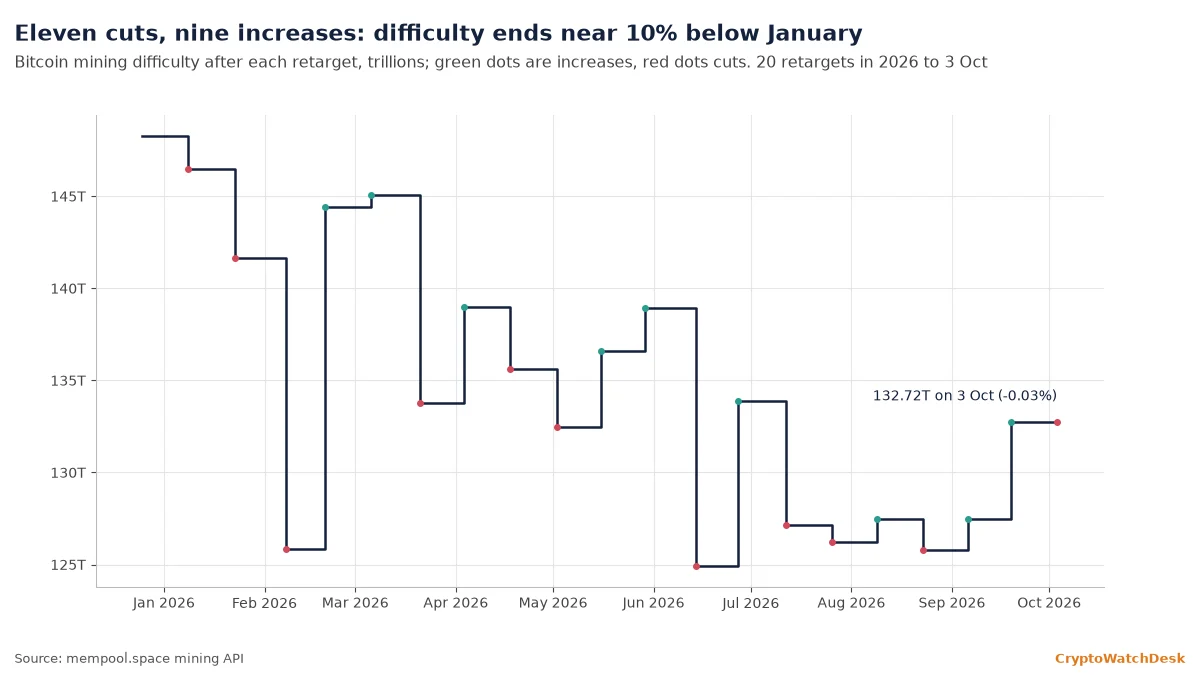
Here is how the year’s adjustments add up, using retarget data from mempool.space:
Counting Saturday’s, there have been 20 retargets this year: nine increases and eleven cuts. The cuts add up to 45.3 percentage points and the increases to 37.5, and difficulty now sits about 10.5% below the 148.26T it started the year at. (Bitcoin.com’s tally of eight increases and a net 11.96% decline appears to leave out the 4.16% rise on 19 Sep.) That is unusual. For most of bitcoin’s history, difficulty has ratcheted upward over a calendar year as more efficient machines arrive. A net decline through three quarters suggests some older or higher-cost capacity has been leaving the network.
And here is what miners were paid for it, month by month:
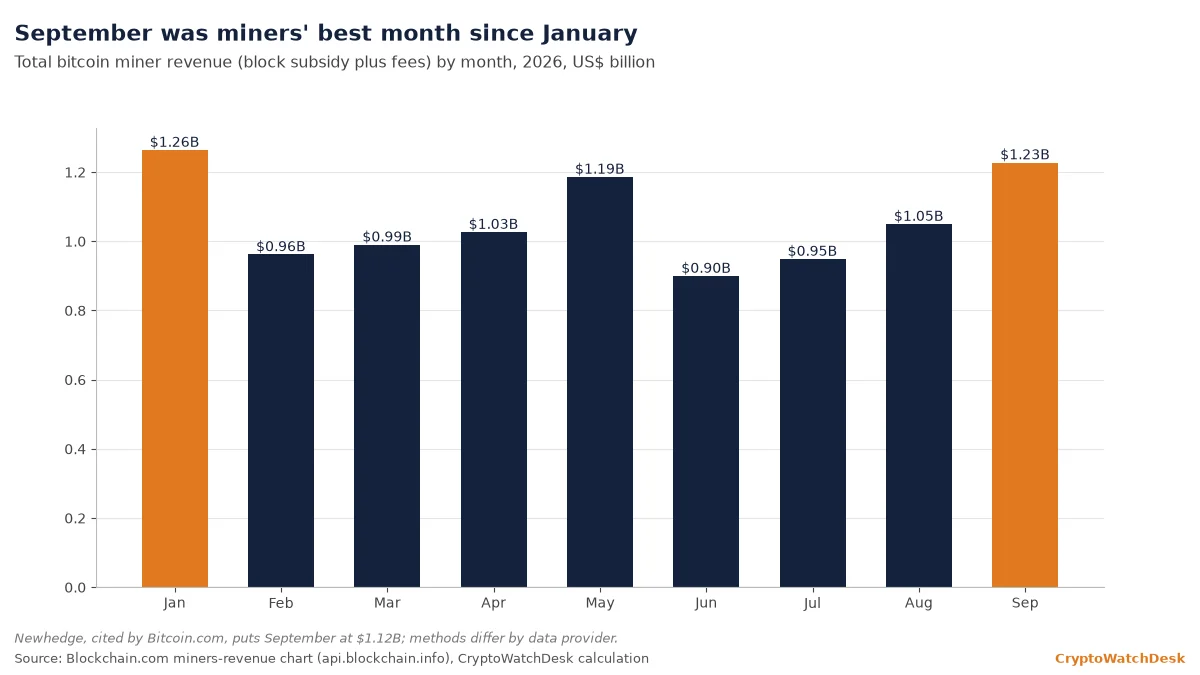
The combination matters more than either number alone. Revenue is set mostly by bitcoin’s price and the fixed block subsidy; cost is set mostly by difficulty and electricity. In September, the first rose while the second held still.
Hashprice, worked through
Hashprice is the daily revenue one petahash per second of mining power can expect to earn. It hovered around $40 per PH/s for most of the past month, with a 30-day range of $37.45 to $41.51, according to Bitcoin.com.
To make that concrete, take an illustrative operator. The efficiency and power price below are my assumptions, not any company’s figures:
- Fleet size: 100 PH/s
- Revenue at $40 per PH/s per day: 100 × $40 = $4,000 a day
- Efficiency of 20 joules per terahash means 100,000 TH/s × 20 W = 2 megawatts, or 48 megawatt-hours a day
- At $50 per megawatt-hour, power costs 48 × $50 = $2,400 a day
- Gross margin before staff, hosting and depreciation: $1,600 a day, or 40%
At the 30-day low of $37.45, the same fleet earns $3,745 and the margin narrows to $1,345. Run the same arithmetic with older machines at 30 J/TH and power costs rise to $3,600 a day, leaving $400. That is the population a net-negative year of difficulty suggests has been switching off.
The base case
I’ll call my base case the level road: difficulty drifting within a few percent either side of today’s level for the rest of the year, because the network’s hashrate, which Bitcoin.com puts just below 1,000 EH/s, is neither collapsing nor surging. On the evidence of the past fortnight, that seems more likely than not in the near term. Blocks are currently arriving every 10 minutes and 48 seconds on average, a little slow, which points to a small cut rather than a rise at the next retarget, expected around 18 Oct.
What would change my mind. Three things. First, a large batch of new-generation machines being energised, which would show up as block times falling well under ten minutes and a sharp rise at the next retarget. Second, a sustained fall in hashprice towards the bottom of its recent range, which would push higher-cost fleets offline again. Third, a large move in bitcoin’s price in either direction, as we saw intraday on Friday (see Friday’s price swing), since price is the biggest single input to hashprice.
The bottom line
A near-zero retarget is easy to dismiss as a non-event. It is better read as a reading of balance: the network’s power, its price and its difficulty all pointed the same way for two weeks. For the wider picture, see our explainer on how bond yields affect bitcoin.
The bottom line: September was the miners’ best month since January, and the 3 Oct retarget says the network has settled onto a level road, for now.
— Alasdair
Data: Bitcoin.com News, ASIC.tools, Newhedge. As of 3 Oct 2026, 17:30 UTC. Not investment advice.
Produced by the Crypto Watch Desk newsroom using AI tools. This article is for information only and is not investment advice.