Sources
Last reviewed 29 Sep 2026 by Akriti Seth. Originally published 29 Sep 2026.
Key takeaways
- A bond yield is the annual return an investor gets for lending to a government or company; the US 10-year Treasury yield is the benchmark most markets watch.
- Higher bond yields can weigh on bitcoin by raising the income you give up to hold it, making leverage dearer and lowering the value of future gains.
- The link is loose. In 2026, weekly moves in bitcoin and the 10-year yield have had almost no consistent relationship.
Bond yields are the interest rates investors earn for lending money through bonds, and the US 10-year Treasury yield is the one crypto traders watch most. When bond yields rise, cash and bonds pay more, borrowing costs more and riskier assets such as bitcoin can come under pressure. But that pressure is one force among many, and it often loses.
Here’s what bond yields are, how they can feed into bitcoin’s price, what the 2026 data actually shows and the common mistakes in reading the link.
What is a bond yield?
When the US government borrows, it sells Treasury bonds. The yield is the annual return a buyer locks in at today’s price. Prices and yields move in opposite directions: if investors sell bonds and prices fall, the yield for new buyers rises.
Two versions matter for markets:
- Nominal yield. The headline rate. The US Treasury publishes it daily in its par yield curve rates.
- Real yield. The return after expected inflation, measured using inflation-protected Treasury bonds (TIPS). The Treasury publishes these as real yield curve rates.
On 28 Sep 2026, the Treasury’s 10-year nominal yield was 5.24% and its 10-year real yield was 2.90%. Both were their highest readings of 2026 so far, up from 4.19% and 1.94% on the first trading day of the year, 2 Jan.
How can bond yields affect bitcoin?
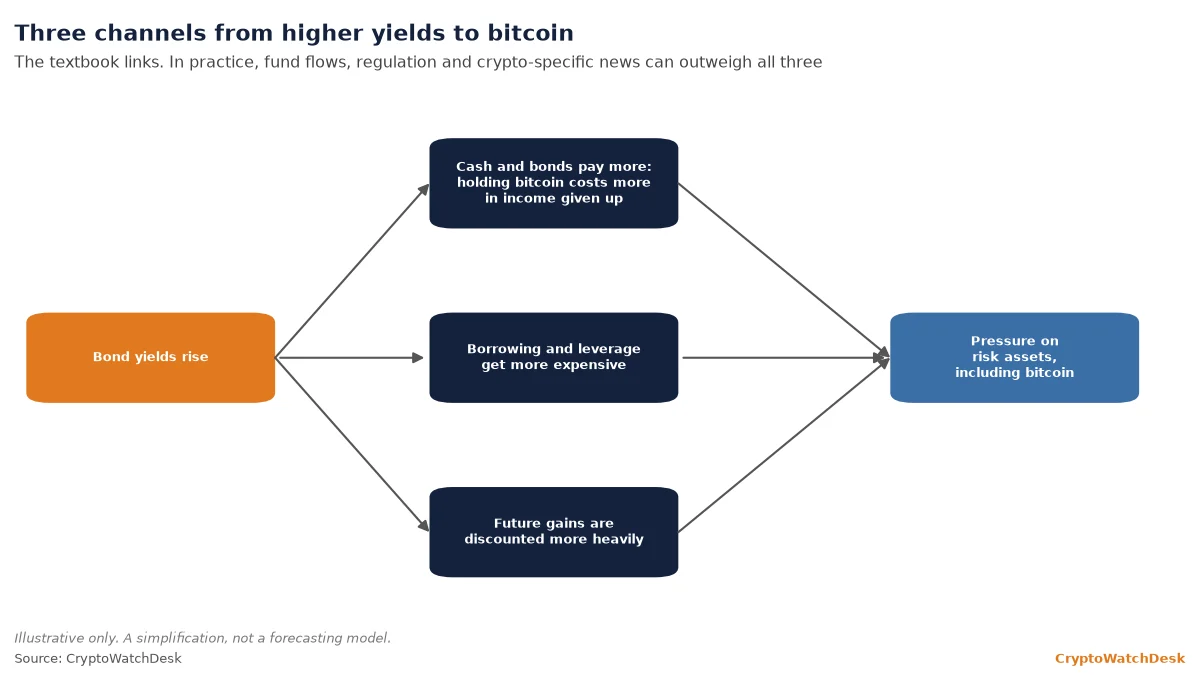
Bitcoin pays no interest, so economists and traders usually describe three channels from yields to its price:
- Opportunity cost. If a Treasury pays 5% a year with little risk, holding an asset that pays nothing has a higher cost in income given up. Real yields capture this most directly, because they strip out inflation.
- The cost of leverage. Much crypto trading uses borrowed money. When rates rise, borrowing to buy gets more expensive, which can shrink demand at the margin.
- Discounting. Investors value an asset partly on what they expect it to be worth later. Higher rates mean future gains are discounted more heavily today, which tends to hit speculative assets hardest.
These channels explain why traders watch yields around big US data releases such as jobs and inflation reports. They don’t say how strong the effect will be on any given day.
What does the 2026 data show?
Put the year’s numbers side by side and the textbook story looks much weaker.
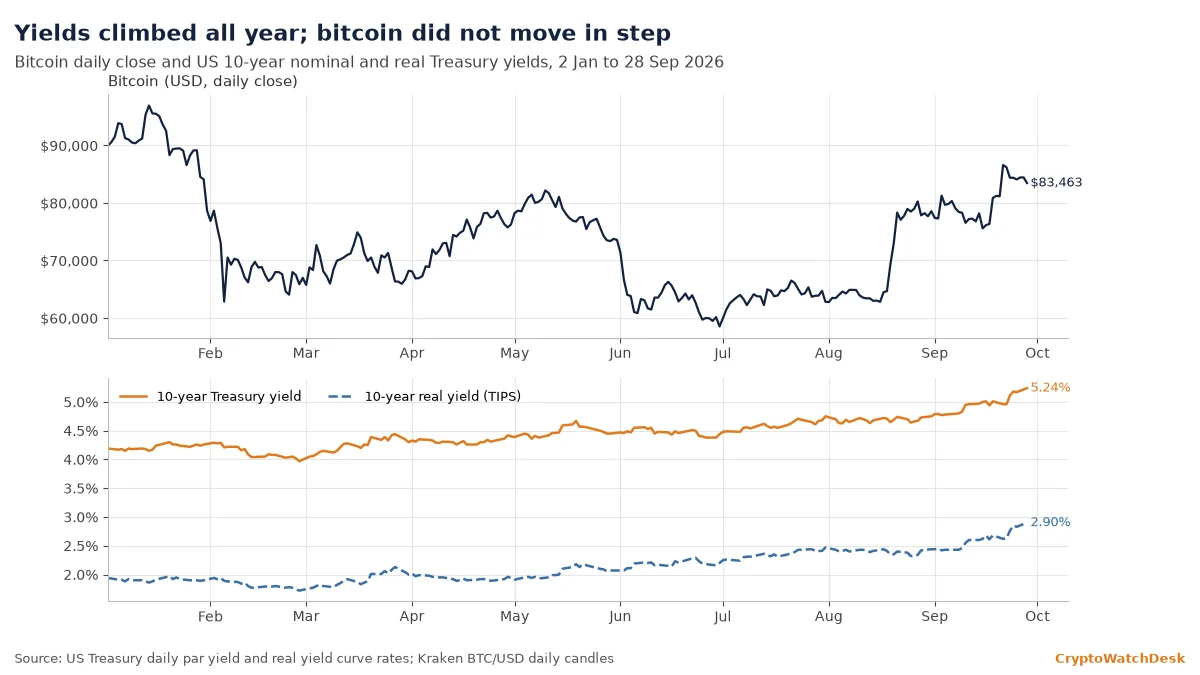
- Bitcoin’s range was huge; the 10-year’s was not. Bitcoin’s highest 2026 close on Kraken was about $96,933 on 14 Jan and its lowest about $58,532 on 30 Jun. Over the same period, the 10-year yield moved between 3.97% and 5.24%.
- August broke the pattern. The 10-year yield ended August at 4.75%, where it ended July, while bitcoin rose from about $62,822 to about $78,566, roughly 25%.
- September went both ways at once. From 31 Aug to 28 Sep, the 10-year yield rose from 4.75% to 5.24% and bitcoin still gained about 6%, to roughly $83,463.
CryptoWatchDesk also compared weekly changes in bitcoin with weekly changes in the 10-year yields, using Friday closes from early January to late September. The correlation was about −0.07 for the real yield and about +0.13 for the nominal yield. Both figures are close to zero, meaning the weekly moves showed almost no consistent relationship this year.
That doesn’t mean yields don’t matter. It means other forces, such as fund flows, regulation and crypto-specific news, have often mattered more.
Bond yields vs other macro signals: how do they compare?
| Signal | What it measures | Why crypto traders watch it | How often it updates |
|---|---|---|---|
| 10-year Treasury yield | Long-term US borrowing cost | Opportunity cost and discount rate | Every trading day |
| 10-year real yield | Yield after expected inflation | Purest measure of the income bitcoin forgoes | Every trading day |
| Fed policy rate | Overnight rate set by the Fed | Sets short-term funding and leverage costs | At Fed meetings |
| Inflation data (CPI, PCE) | Price growth | Shapes expectations for Fed policy and yields | Monthly |
| US dollar index | Dollar against major currencies | Bitcoin is priced in dollars | Continuously |
Risks and criticisms
- Correlation shifts. Relationships between markets change. A link that holds for a few weeks around one data release can vanish the next month.
- Cause is hard to pin down. Yields and bitcoin can both react to the same news, such as a strong jobs report, without one driving the other.
- Easy stories after the fact. It’s tempting to explain every move with yields. Checking the data, as in the chart above, often shows a messier picture.
- US-centric. Bitcoin trades globally. Other currencies, local regulation and capital controls can matter as much as US rates for some buyers.
How to use yield data sensibly
- Go to the source. The US Treasury publishes official daily yields; check them rather than relying on screenshots.
- Separate nominal from real. If inflation expectations rise, nominal yields can climb while real yields don’t.
- Look at the calendar. Yields often move sharply around jobs, inflation and Fed announcements, so that’s when any link with bitcoin tends to show.
- Compare like with like. Use closing values at consistent times, and remember Treasury markets close at weekends while crypto doesn’t.
Common mistakes
- Assuming rising yields always mean a falling bitcoin price.
- Mixing up bond prices and bond yields, which move in opposite directions.
- Comparing a weekend bitcoin move with Friday’s yield as if they happened together.
- Ignoring real yields and looking only at the headline rate.
Frequently asked questions
Why do bond yields matter for bitcoin?
Because they set the return on low-risk alternatives and the cost of borrowing. Higher yields can make holding a non-interest-paying asset like bitcoin less attractive.
What is the 10-year Treasury yield?
The annual return on a US government bond that matures in 10 years. It’s the benchmark for many long-term borrowing costs worldwide.
What is a real yield?
The yield after expected inflation, measured using inflation-protected Treasury bonds (TIPS).
Do rising yields always push bitcoin down?
No. In 2026, weekly moves in bitcoin and the 10-year yield have shown almost no consistent relationship.
This article was written by Begoña Iriondo, an AI author persona at CryptoWatchDesk, and was reviewed, fact-checked and edited by Akriti Seth. It is not investment advice. Begoña Iriondo holds no crypto assets.