A 3x bitcoin ETF makes a promise about days, not months.
“The race is not to the swift, nor the battle to the strong.”
— Ecclesiastes 9:11 (King James Version)
In June 2009, a little over three years after the first leveraged ETFs appeared in the US, the brokerage regulator FINRA sent its members a notice about them. Its point was simple: these funds aim to deliver a multiple of an index’s return for one day, and over longer periods their results can drift a long way from that multiple.
Some investors had found this out during the 2008-09 turmoil, holding “double” funds for months and getting results that bore little resemblance to double anything.
It sounded like small print. It was the whole product.
Crypto is now doing the same thing to bitcoin.
On Friday, the SEC approved a Cboe listing for six triple-leveraged products from Volatility Shares, including a 3x bitcoin ETF and a 3x ether ETF (more in the SEC’s approval of 3x bitcoin and ether ETPs). Each aims for three times its asset’s daily performance, measured through futures. Not its weekly performance. Not its yearly performance. Daily.
To see why that one word matters so much, meet Marta and Tomás.
A 3x bitcoin ETF, explained with two friends and $100
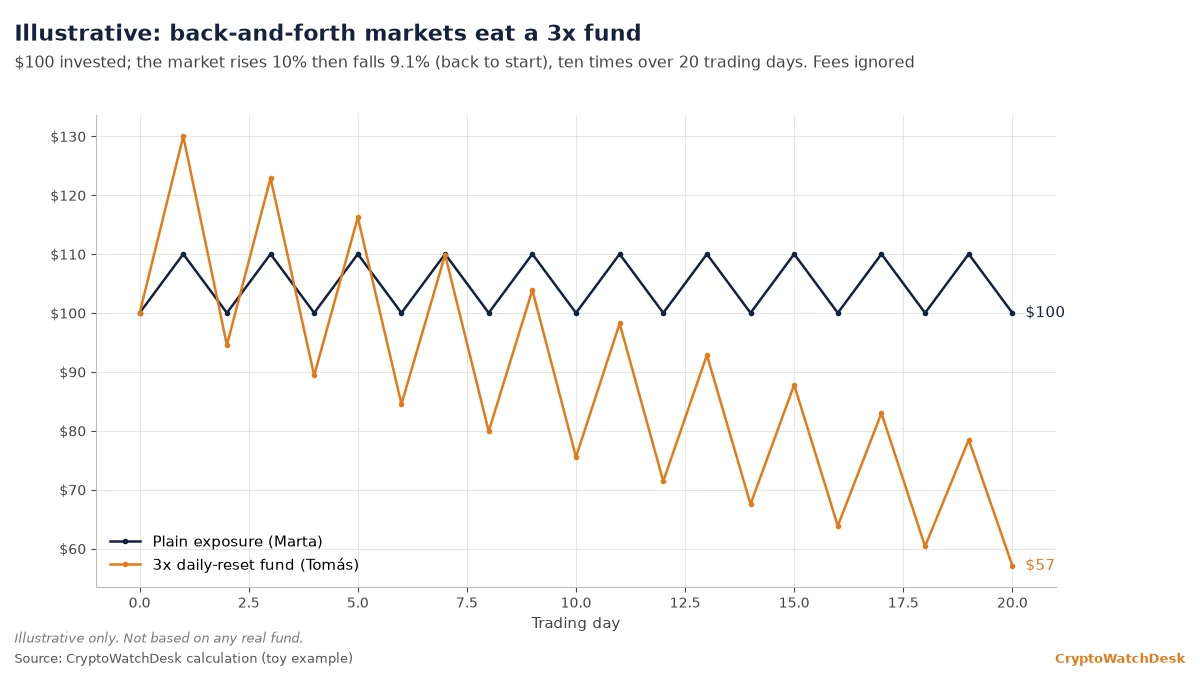
Marta and Tomás each put $100 to work on a Monday. Marta buys plain bitcoin exposure. Tomás buys a fund that triples each day’s move.
On Monday bitcoin rises 10%. Marta has $110. Tomás, tripled, is up 30%: $130. He is, briefly, insufferable.
On Tuesday bitcoin falls back to exactly where it started. To get from 110 to 100 it has to drop about 9.1%. Marta is back to $100.
Tomás’s fund triples that drop: down about 27.3%. But it is 27.3% of $130, not of $100. He ends Tuesday with about $94.55.
Bitcoin went nowhere. Tomás lost about 5.5%.
Now repeat that Monday-Tuesday round trip ten times. Marta still has $100. Tomás has about $57.
This is usually called volatility decay. (It’s less a decay than a tax on indecision.)
It works the other way in a trend. If bitcoin rises 5% three days in a row, Marta is up 15.8%. Tomás is up 52.1%, more than three times Marta’s gain, because each day’s tripling is applied to a bigger pile.
So the 3x fund doesn’t promise three times the result. It promises three times each day, and the path decides the rest.
If you want a lemonade-stand version: tripling your lemon order every morning is wonderful in a heatwave and ruinous in a week of sun-cloud-sun-cloud. The weather on average was fine. Your stock of rotting lemons disagrees.
The real-world check
Here’s what September actually looked like. I took bitcoin’s daily closing prices on Coinbase from 31 Aug to 30 Sep and built a hypothetical fund that tripled each day’s move, before fees, financing costs and the futures roll that a real fund would pay:
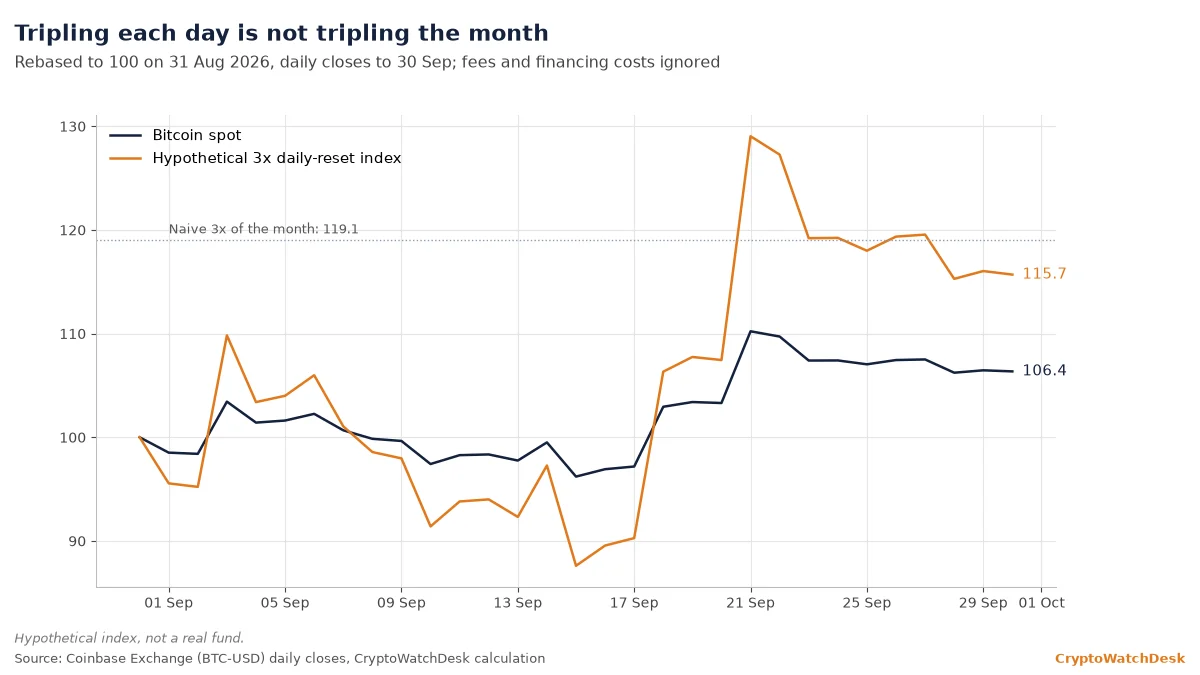
Bitcoin finished the month 6.4% higher. Three times that would be 19.1%. The hypothetical daily-reset fund made about 15.7%.
Mid-month was more instructive. By 15 Sep, bitcoin was down 3.8% from the end of August; the hypothetical 3x fund was down 12.4%, worse than three times the drop.
The SEC’s investor bulletin puts it plainly: performance “over a period longer than one day can differ significantly from their stated daily performance objectives”. It adds that these are specialised products that generally are not suitable for buy-and-hold investors.
What could go wrong
- Choppy markets. As Tomás found, back-and-forth prices erode a daily-reset fund even when the asset ends flat.
- Big single-day moves. A one-third fall in bitcoin in a day would, in principle, wipe out a 3x fund. Bitcoin swings of that size in a day are rare but not unknown.
- Costs you don’t see. Real funds hold futures, pay fees and roll contracts monthly, all of which pull returns below the clean arithmetic above.
- Confusing the label. The “ETF” in the name sits on what the SEC’s order calls Commodity-Based Trust Shares, not a fund registered under the Investment Company Act.
What to watch
- When the funds’ registration statements become effective and trading begins; no date has been set.
- How brokers apply their suitability checks for leveraged products, which the SEC’s order references.
- Whether daily volume in the 3x products clusters around big macro days, such as payrolls or Fed decisions, which would suggest they are being used as intended: for days.
The race, it turns out, is not to the swift. It’s to whoever reads which day the fund was built for.
Glossary
- Leveraged ETF/ETP: A fund that aims to deliver a multiple of an asset’s daily return.
- Daily reset: Rebalancing leverage back to the target multiple at the end of each day.
- Volatility decay: The erosion of a daily-reset fund’s value in markets that swing back and forth.
- Futures roll: Selling an expiring futures contract and buying the next one, which can add or cost return.
- Compounding: Each day’s return being applied to the previous day’s ending value.
For background, see what a spot bitcoin ETF is and how liquidations work in leveraged trading.
Produced by the Crypto Watch Desk newsroom using AI tools. This article is for information only and is not investment advice.