Sources
Last reviewed 28 Sep 2026 by Akriti Seth. Originally published 28 Sep 2026.
Key takeaways
- A spot Bitcoin ETF is a fund that holds bitcoin and lists its shares on a stock exchange, so you can get bitcoin price exposure through an ordinary brokerage account.
- A custodian holds the fund’s bitcoin. You own fund shares, not coins, and you cannot withdraw bitcoin to your own wallet.
- The main costs and risks are bitcoin’s volatility, the fund’s annual fee, small tracking gaps, and reliance on the custodian and other service providers.
A spot Bitcoin ETF is an exchange-traded fund that owns actual bitcoin and issues shares that trade on a stock exchange during market hours. Its share price is designed to follow bitcoin’s market price, minus the fund’s fee. You buy it like a stock, through a broker; the fund’s custodian keeps the bitcoin.
This guide explains how the fund creates and cancels shares, who runs the US products, how a spot fund differs from a futures fund and from owning bitcoin directly, what it costs, and what can go wrong.
How does a spot Bitcoin ETF work?
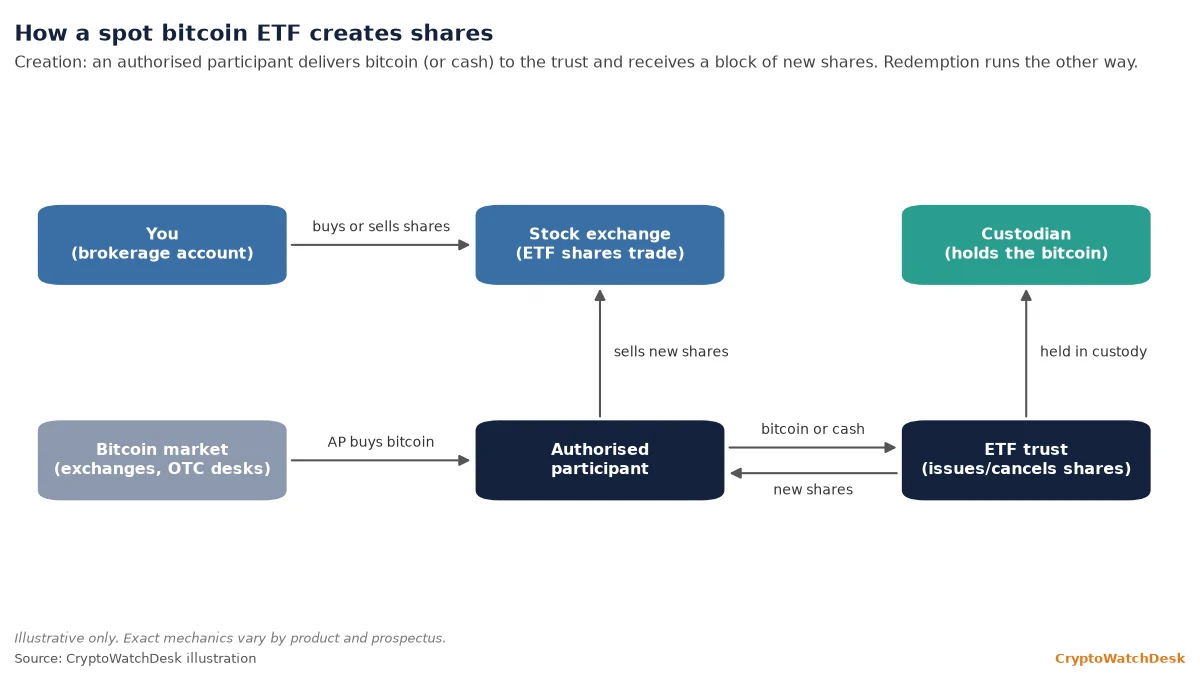
An ETF is a wrapper: a legal structure that holds an asset and sells slices of it as shares. A spot bitcoin ETF’s asset is bitcoin itself, bought on the market and held by a custodian, a specialist firm that stores the private keys.
The number of shares is not fixed. When investors want more shares than exist, large trading firms called authorised participants (APs) step in. An AP delivers bitcoin, or cash the fund uses to buy bitcoin, and receives a block of new shares in return. This is called a creation. When investors sell and demand falls, the AP hands shares back and receives bitcoin or cash. That is a redemption, and the fund shrinks.
This creation and redemption loop keeps the share price close to the value of the bitcoin each share represents. If shares trade above that value, an AP can create new shares and sell them at a profit, which pushes the price back down. If shares trade below it, an AP can buy cheap shares and redeem them. The daily net of creations and redemptions is what flow trackers such as Farside Investors report as “inflows” and “outflows”.
A toy example: suppose a fund holds 1,000 bitcoin and has 1,000,000 shares outstanding. Each share represents 0.001 BTC. If bitcoin trades at $80,000, each share is worth about $80, before fees. If an AP delivers 10 more bitcoin, the fund issues 10,000 new shares, and each share still represents 0.001 BTC.
When the US first approved these funds, creations had to be made in cash: the AP handed over dollars and the fund bought the bitcoin. In July 2025 the US Securities and Exchange Commission approved in-kind creations and redemptions, which let APs deliver and receive bitcoin directly.
Who issues the US spot Bitcoin ETFs?
The SEC approved the first US spot bitcoin exchange-traded products on 10 Jan 2024, and 11 began trading the next day. The sponsors include BlackRock (iShares Bitcoin Trust, IBIT), Fidelity (FBTC), Bitwise (BITB), ARK Invest with 21Shares (ARKB), Invesco Galaxy (BTCO), VanEck (HODL), Franklin Templeton (EZBC) and Grayscale. Grayscale converted its older Grayscale Bitcoin Trust (GBTC) into an ETF and later added a lower-fee Bitcoin Mini Trust.
Before conversion, GBTC was a closed-end trust that could not create and redeem freely, and its shares traded at a discount of nearly 50% to the value of its bitcoin at the end of 2022. That episode is the clearest illustration of why the creation and redemption mechanism matters.
How big are the flows?
Flows are the most-watched number in the sector because they are a direct measure of new money. US spot bitcoin ETFs took in about $2.39 billion in the week to 25 Sep 2026, their largest week since October 2025, according to Farside Investors data. They lost about $4.9 billion in the second quarter of 2026. Flows swing both ways, and a single big day is not a forecast.
Spot Bitcoin ETFs outside the United States
The US was not first. Canada’s Purpose Bitcoin ETF began trading in Toronto in February 2021 and is widely cited as the world’s first spot bitcoin ETF. Hong Kong approved spot bitcoin and ether funds in April 2024.
Europe works differently. EU rules for retail investment funds, known as UCITS, do not allow a fund to hold bitcoin directly. So most European bitcoin products are exchange-traded products or exchange-traded notes. Some are backed by bitcoin held in custody; others are debt instruments whose value tracks bitcoin. In the UK, the Financial Conduct Authority allowed retail investors to buy crypto exchange-traded notes from 8 Oct 2025, after a ban that dated from 2021. The label on the product matters less than what backs it and who you would be a creditor of if something failed.
How to read ETF flow data
Flow tables list each fund’s net creations or redemptions in dollars for one trading day. Three habits help. First, look at the total and at the spread across funds: a day when one fund takes in money while several others lose it is weaker than the headline suggests. Second, compare the day with the recent run, not with the record. Third, remember the timing. US funds report after the market closes, so a “Monday flow” number usually becomes public late on Monday or on Tuesday morning in Europe.
How is a spot Bitcoin ETF different from a futures ETF or owning bitcoin?
| Feature | Spot Bitcoin ETF | Bitcoin futures ETF | Owning bitcoin directly |
|---|---|---|---|
| What you hold | Fund shares backed by bitcoin | Fund shares backed by futures contracts | Bitcoin, controlled by your keys or an exchange |
| Who holds the bitcoin | The fund’s custodian | No bitcoin; the fund holds contracts | You, or the exchange you use |
| Tracks | Spot bitcoin price, minus fees | Futures prices, which can drift from spot | Spot price |
| Extra cost | Annual fee | Annual fee plus the cost of rolling expiring contracts | Trading and withdrawal fees |
| Trading hours | Stock-exchange hours | Stock-exchange hours | 24/7 |
| Can you send it on-chain? | No | No | Yes |
The first US bitcoin futures ETF, ProShares’ BITO, launched in October 2021, more than two years before spot funds were allowed. Futures funds must sell expiring contracts and buy later ones. When later contracts cost more, that “roll” eats into returns.
What does a spot Bitcoin ETF cost?
The main cost is the expense ratio, an annual fee taken from the fund’s assets. At launch in January 2024, most sponsors charged roughly 0.2% to 0.25% a year, while GBTC kept a 1.5% fee. On a $10,000 holding, that is about $25 a year against $150. Fees change, and some sponsors waived them for a period, so check the current prospectus.
You also pay your broker’s commission, if any, and the bid-ask spread on the shares. Taxes depend on where you live and the type of account; in the US, the IRS treats sales of fund shares like sales of other securities.
What could go wrong? Risks and criticisms
- Price risk. The fund follows bitcoin. If bitcoin falls 30%, the shares fall about 30%.
- Fees compound. A small annual fee is still a drag over many years, compared with holding bitcoin yourself.
- Premiums and discounts. Shares can trade slightly above or below the value of their bitcoin, especially when the US market is open but bitcoin is moving fast, or around weekends when bitcoin trades and the stock market does not.
- Custody and operations. You rely on the custodian’s security and on the fund’s administrators. Several funds share the same custodian, which concentrates that risk.
- Market hours. You can only trade when the stock exchange is open. Bitcoin can move sharply overnight or at weekends.
- Criticism from bitcoin users. A common objection is “not your keys, not your coins”: ETF holders cannot use the bitcoin network, and large funds concentrate coins with a few custodians.
- Rule changes. Tax treatment, listing rules and fund structures can change.
How to choose and use a spot Bitcoin ETF
- Check that your broker offers the fund and that it is a spot product, not a futures or leveraged fund.
- Compare the expense ratio, assets under management and trading volume.
- Read the prospectus sections on custody and on creations and redemptions.
- Size the position for volatility. Bitcoin regularly moves several percent in a day.
- If you want to use bitcoin, not just own its price, an ETF is the wrong tool.
Frequently asked questions
Does a spot Bitcoin ETF give me bitcoin in my wallet?
No. You own fund shares. The custodian holds the fund’s bitcoin.
What is the difference between a spot ETF and a futures ETF?
A spot fund holds bitcoin. A futures fund holds contracts that expire and must be rolled.
Can ETF flows move the bitcoin price?
Creations add bitcoin demand and redemptions add supply, so large flows can matter. They are one demand channel among many.
Are European bitcoin products the same?
No. In Europe most bitcoin funds are exchange-traded products or notes with different legal structures and investor protections. Check the local offering documents.
Common mistakes
- Thinking ETF shares can be withdrawn as bitcoin.
- Buying a futures, leveraged or inverse product by mistake because the ticker looks similar.
- Comparing funds on price per share instead of fee and tracking.
- Treating one day of inflows as a price forecast.
- Skipping the prospectus sections on custody and creations.
Produced by the Crypto Watch Desk newsroom using AI tools. This article is for information only and is not investment advice.