
Paragraph 7 of a short explanatory vote from Brazil’s central bank, Vote 108/2026, gives the reason for a one-week delay that every crypto company in the country will now plan around. The Banco Central do Brasil (BCB) needed time, it said, to compile and publish an official list of firms in transition to its new licensing regime, according to FinanceFeeds, which reviewed the document.
The delay came through Resolution BCB 589, published in the official gazette on 25 Sep. It moves the date from which banks and payment institutions must stop carrying out or facilitating virtual-asset operations with non-compliant crypto counterparties from 30 Oct to 6 Nov.
It also changes the words. The earlier text, in Resolution BCB 520, protected providers that were authorised or “in the process of authorisation”. The new text refers only to counterparties that are not authorised, FinanceFeeds reported.
How Brazil got here
Brazil’s crypto rulebook has been a long time coming. Congress passed the legal framework for virtual-asset service providers in December 2022, as Law 14,478, and a 2023 presidential decree named the central bank as the supervisor. The detailed rules followed on 10 Nov 2025, when the BCB published Resolutions 519, 520 and 521, which took effect on 2 Feb 2026, according to a client alert from law firm Pinheiro Neto.
Under those rules, a crypto business needs BCB authorisation as one of three types of provider, known by the Portuguese acronym SPSAV: an intermediary, a custodian or a broker. Firms already operating on 2 Feb were given 270 days to file, which is how 30 Oct became the date the industry has been working towards all year. Resolution 521 separately brought certain crypto operations into the country’s foreign-exchange and foreign-capital rules, with reporting obligations that began on 4 May.
The original design was forgiving to incumbents. A firm that had filed on time could keep operating while the central bank reviewed its application, and banks could keep serving it. Resolution 589’s new wording for Article 91 is the first sign that the protection for firms “in the process” may be narrower in practice than the industry assumed.
Brazil crypto licensing in numbers
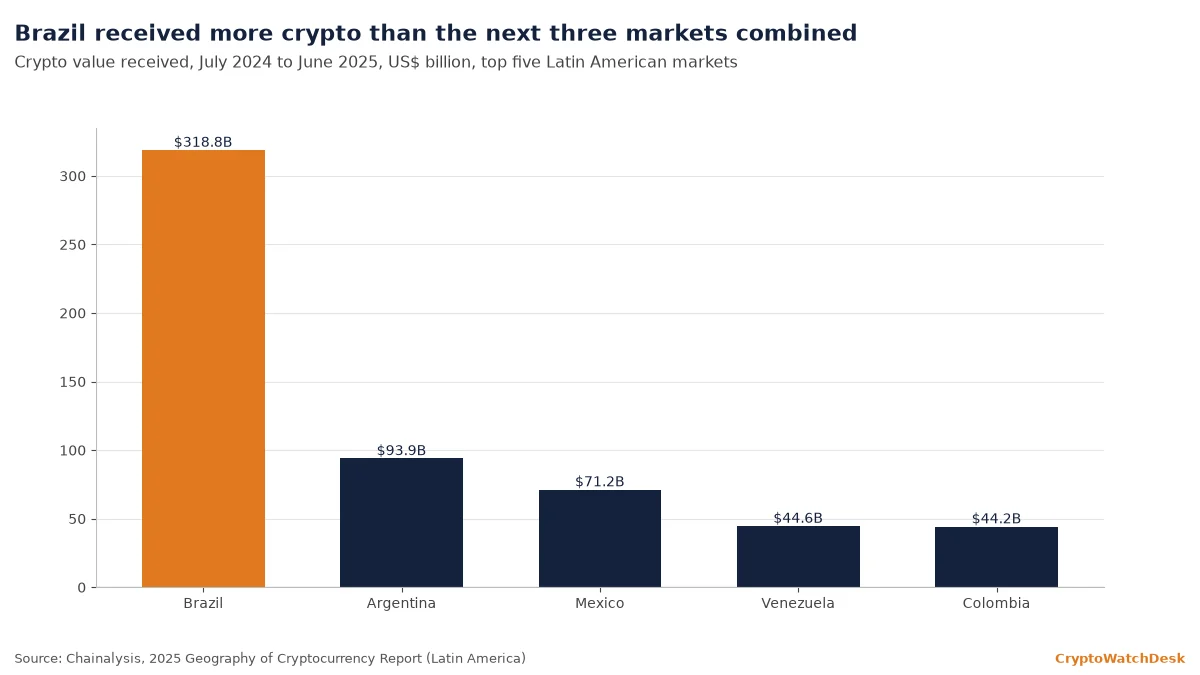
The stakes are large. Brazil received about R$1.59 trillion ($318.8 billion / €284.5 billion) in crypto value between July 2024 and June 2025, nearly a third of Latin America’s total and more than double the previous year, according to Chainalysis. That put it fifth in the firm’s 2025 global adoption index. Chainalysis also cited officials saying more than 90% of Brazilian crypto flows are now stablecoin-related, which suggests much of this activity is payments and dollar savings rather than trading alone.
Most of that volume runs through centralised platforms seeking licences and the banks that serve them. A gap in bank access, even for a few weeks, would land on ordinary users who send money abroad or keep savings in dollar tokens.
Related: Emerging-market stablecoin use
Conversions use ECB reference rates for 5 Oct (USD/BRL 4.9847, EUR/USD 1.1204). Chainalysis figures are measured in US dollars.
Compared with what? Brazil now has three dates that sit within a week of each other, and they do different jobs.
- 30 Oct remains the Phase 1 deadline for existing virtual-asset service providers, known locally as PSAVs, to file for authorisation, under Normative Instruction 704.
- 6 Nov is the new date from which regulated banks and payment institutions must stop dealing with unauthorised crypto firms.
- 25 Aug was the date of the BCB’s first known licence refusal, against Higherway Tech Soluções, which trades as Higher Global Payments; it was published in the official gazette on 28 Sep without a stated reason, according to FinanceFeeds. Higher Global said it was reviewing the decision with advisers.
Public process searches had surfaced only seven applications still moving through the BCB by early October, FinanceFeeds reported: Transfero, Mazzera, PFPAY, Masterpay, W Brasil, Onda Finance and Wynx. That is a short list for a market of Brazil’s size, though several larger exchanges have said publicly that they intend to apply. This count comes from a single outlet’s searches and has not been independently confirmed by CryptoWatchDesk.
Old wording: providers neither authorised nor “in the process of authorisation”. New wording: counterparties that “are not authorised”.
— Article 91 of Resolution BCB 520, as amended by Resolution BCB 589, as reported by FinanceFeeds (translated)
The list that decides
The practical question is what happens to a firm whose application is still pending on 6 Nov. The BCB has said it will publish a list of institutions in transition, including providers that have filed and eligible institutions that notified it of their intention to operate. As of 6 Oct, FinanceFeeds said it could not find that list on the bank’s public pages.
That list is now the document that matters most for banks’ compliance teams. Without it, a bank deciding whether to keep processing a crypto firm’s payments has the regulation’s new wording and little else.
Related: How MiCA licensing deadlines played out in Europe
The bank has also signalled it can move fast on refusals. André Zanon, a BCB official, said at an industry webinar on 29 Sep that the regulator intends to accelerate refusals where basic Phase 1 requirements fail, such as controllers’ reputation, capital, or proof that a firm was operating when the regime took effect, FinanceFeeds reported.
Users are already feeling the transition. Bity is ending its crypto services in Brazil, FinanceFeeds reported on 5 Oct, with Bitybank customers directed to Mercado Bitcoin and BityPreço users to Bipa. Other firms have restructured products or left retail business rather than file.
Compared with Europe, Brazil’s timetable is tight but not unusual. The EU’s Markets in Crypto-Assets Regulation let member states give existing firms until 1 July 2026 at the latest to obtain a licence, and several firms there also waited until close to the deadline. The difference in Brazil is that the cut-off is enforced through the banks: a firm that falls outside the list does not just lose a licence, it can lose its payment rails.
For customers, the practical checks before 6 Nov are modest. Find out whether your platform has filed for authorisation, and whether it appears on the central bank’s list once that is published. Note any notice about changes to deposits or withdrawals in reais, because those depend on the bank relationship the new Article 91 governs. If a platform announces an exit, as Bity has, follow its migration instructions from official channels only.
The risks are concrete. A firm that misses the list could lose access to bank rails while its application is still under review, and its customers could face forced withdrawals or migrations on short notice. Every consolidation phase also invites impostors posing as “licensed” platforms, and users should check any claim against the central bank’s own register once it is published.
Brazil’s next milestone is not another resolution or a speech. It is the list promised in paragraph 7 of Vote 108.
This article is for information only and is not investment advice.