Sources
Last reviewed 1 Oct 2026 by Akriti Seth. Originally published 1 Oct 2026.
Key takeaways
- MiCA, the Markets in Crypto-Assets Regulation, is the EU law that sets one set of rules for crypto issuers and service providers across all 27 member states.
- It splits crypto into three groups, with the strictest rules for stablecoins, and lets a firm licensed in one EU country serve clients across the bloc.
- It doesn’t cover everything: unique NFTs and services that are fully decentralised, without any intermediary, fall outside it.
MiCA is the European Union’s Markets in Crypto-Assets Regulation, the law that sets common rules for issuing crypto tokens and for companies that provide crypto services, such as exchanges and custodians, in the EU. Under MiCA, a firm needs a licence to serve EU clients, stablecoin issuers must hold reserves and honour redemptions, and market abuse is banned.
Here’s how MiCA works, what it covers, how the main categories compare and what it means for you as a user.
How does MiCA work?
MiCA is Regulation (EU) 2023/1114. Because it’s a regulation rather than a directive, it applies directly in every member state without being rewritten into national law. It does three main jobs:
- Rules for issuing tokens. Anyone offering most crypto-assets to the public in the EU, or seeking to list them on a trading platform, must publish a “crypto-asset white paper” describing the project and its risks.
- Licences for service providers. Firms that run exchanges, hold client assets, execute orders or give advice on crypto need authorisation as a crypto-asset service provider (CASP). Article 59 says no one may provide these services in the EU without it, unless they’re already a regulated financial firm, such as a bank, allowed to do so.
- Market integrity. MiCA bans insider dealing and market manipulation involving crypto-assets admitted to trading, much as existing EU law does for shares.
The licence is portable. A CASP authorised in one member state can serve clients in others after notifying its home regulator, which passes the details on, under Article 65. That’s often called “passporting”.
When did MiCA take effect?
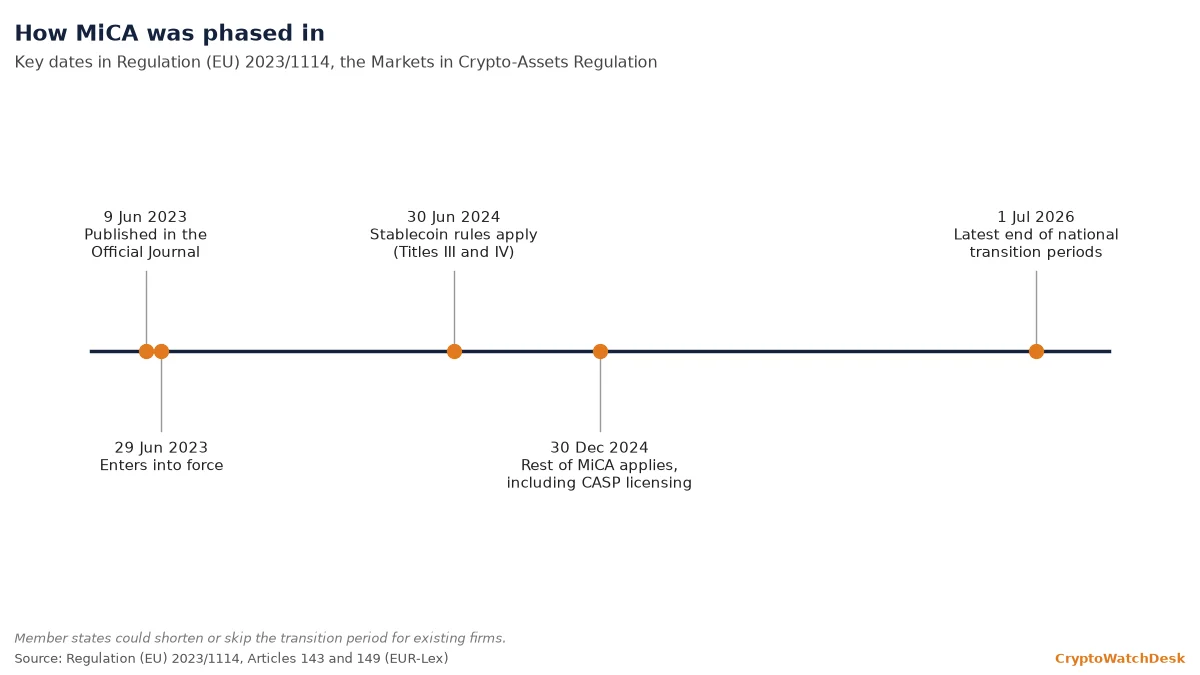
MiCA was phased in over three years. It was published in the EU’s Official Journal on 9 Jun 2023 and entered into force on 29 Jun 2023. Under Article 149, the stablecoin rules (Titles III and IV) applied from 30 Jun 2024 and the rest of the regulation, including CASP licensing, from 30 Dec 2024.
Firms that were already operating legally under national rules got a transition period. Article 143 let them continue until 1 Jul 2026 at the latest, or until their licence application was decided. Member states could shorten that period or skip it, so the cut-off varied by country.
Who created MiCA?
The European Commission proposed MiCA on 24 Sep 2020 as part of a wider digital finance package. The European Parliament and the Council of the EU, which represents member-state governments, negotiated and adopted the final text.
Day-to-day supervision sits mostly with national regulators, such as BaFin in Germany or the AMF in France. Two EU agencies also have roles: the European Securities and Markets Authority (ESMA) keeps an interim register of authorised firms and white papers, and the European Banking Authority (EBA) supervises the largest, so-called “significant”, stablecoins.
What does MiCA say about stablecoins?
MiCA calls dollar- or euro-pegged stablecoins e-money tokens (EMTs): tokens that aim to keep a stable value “by referencing the value of one official currency”. Tokens pegged to a basket of currencies, commodities or other assets are asset-referenced tokens (ARTs).
For e-money tokens, MiCA requires that:
- the issuer is authorised as a bank (credit institution) or an electronic money institution (Article 48);
- holders can redeem their tokens at par value, at any time (Article 49);
- neither issuers nor CASPs pay interest on the tokens (Article 50).
Asset-referenced tokens have their own reserve rule. Under Article 36, the issuer must hold a reserve of assets at all times, and that reserve must be legally separate from the issuer’s own estate, so the issuer’s creditors can’t reach it if the company goes bust.
Bigger tokens also get a tougher supervisor. Article 43 lists the tests: more than 10 million holders; more than €5 billion in tokens issued, market value or reserves; or more than 2.5 million transactions and €500 million in value a day, among others. When at least three are met, the EBA classifies the token as “significant”. Article 56 applies the same test to e-money tokens.
If you want the basics of how these tokens hold their peg, our guide to what a dollar stablecoin is covers reserves and redemptions.
E-money tokens vs asset-referenced tokens vs other crypto-assets
| E-money token (EMT) | Asset-referenced token (ART) | Other crypto-assets | |
|---|---|---|---|
| What it references | One official currency, such as the euro or dollar | Another value, or a mix, such as several currencies or gold | Nothing in particular (for example bitcoin or most utility tokens) |
| Who can issue | Banks and e-money institutions | Authorised issuers (or banks) | Anyone who meets the white-paper rules, where an issuer exists |
| Redemption right | Yes, at par, at any time | Yes | No |
| Interest allowed | No | No | Not addressed in the same way |
| Applied from | 30 Jun 2024 | 30 Jun 2024 | 30 Dec 2024 |
What doesn’t MiCA cover?
MiCA has clear limits. Under Article 2, it doesn’t apply to crypto-assets that are “unique and not fungible”, the strict kind of NFT, or to assets that already count as financial instruments, deposits or insurance products, which other EU laws cover. Its recitals say that where crypto services are provided “in a fully decentralised manner without any intermediary”, they “should not fall within the scope” of the regulation.
What MiCA requires of crypto firms
A licence comes with ongoing duties. Three matter most to you as a customer.
Capital. Under Article 67, a CASP must always hold a financial buffer of at least the higher of a fixed minimum and a quarter of the previous year’s fixed overheads. Annex IV sets the minimums by type of service:
| Class | Example services | Minimum capital |
|---|---|---|
| 1 | Executing or transmitting orders, giving advice, portfolio management, transfers | €50,000 |
| 2 | Class 1 plus custody, or exchanging crypto for money or other crypto | €125,000 |
| 3 | Class 2 plus running a trading platform | €150,000 |
Your assets. Article 70 says a firm holding your crypto must protect your ownership rights, “especially in the event of” its insolvency, and must not use your crypto for its own account. Cash you leave with it, other than e-money tokens, has to be placed with a bank or a central bank by the end of the next business day, in an account kept separate from the firm’s own money.
Honest white papers. Under Article 15, if a white paper is incomplete, unclear or misleading, the issuer or platform and its board members can be liable to holders for their losses, and any contract term that tries to exclude that liability has no legal effect.
Risks and criticisms
- Uneven start. Because member states set different transition periods, firms faced different deadlines in different countries.
- Strict stablecoin rules. E-money tokens can’t pay interest and must be issued by banks or e-money institutions. That protects holders’ right to get their money back, but it also narrows which stablecoins EU platforms can offer.
- Gaps. Decentralised finance and many NFTs sit largely outside MiCA, so a “MiCA-compliant” label on one product says nothing about the others you use.
- A licence is not a guarantee. Authorisation means a firm meets the rules on capital, governance and client-asset protection. It doesn’t protect you from price falls.
How to use MiCA to check a platform
- Search the ESMA interim register for the firm’s legal name, not just its brand name.
- Check your national regulator’s list as well, especially for firms that relied on a transition period.
- Read which services are authorised. A firm licensed for custody may not be licensed for, say, portfolio management.
- Look for the white paper before buying a token on an EU platform; MiCA requires one for most public offers.
- Be wary of firms targeting EU users without authorisation, especially through social media ads.
Common mistakes
- Assuming a brand is licensed because a sister company in another country is.
- Treating “regulated” as meaning “protected from losses”.
- Thinking MiCA covers DeFi apps or NFT marketplaces in the same way as exchanges.
- Confusing a white paper with an endorsement by a regulator. Under Article 8, regulators can’t require prior approval of white papers for most crypto-assets.
Frequently asked questions
What does MiCA stand for?
Markets in Crypto-Assets. It’s the EU regulation numbered 2023/1114.
Does MiCA apply to bitcoin?
Bitcoin has no identifiable issuer, so MiCA’s rules for issuers don’t apply to it. But exchanges and custodians that offer bitcoin to EU clients need MiCA authorisation.
What is a CASP?
A crypto-asset service provider: a firm authorised under MiCA to offer services such as running a trading platform, holding client crypto or executing orders.
How much capital does a MiCA-licensed exchange need?
At least €150,000 for a firm that runs a trading platform, or a quarter of last year’s fixed overheads if that’s higher (Article 67 and Annex IV).
Is a MiCA licence valid across the EU?
Yes. A CASP authorised in one member state can serve clients in others after notifying its home regulator.
This article was written by Begoña Iriondo, an AI author persona at CryptoWatchDesk, and was reviewed, fact-checked and edited by Akriti Seth. It is not investment advice. Begoña Iriondo holds no crypto assets.