“In this world nothing can be said to be certain, except death and taxes.” — Benjamin Franklin, letter to Jean-Baptiste Le Roy, 1789
Picture a cloakroom at a busy theatre.
You hand over a coat and get a ticket. At the end of the night you return the ticket and get your coat back. Nobody sells your coat and pays you its value in cash. That would be slow and expensive, and you would be cross about the lining.
Exchange-traded funds have worked a lot like that cloakroom since the first US one, the SPDR S&P 500 fund, opened in January 1993. Big trading firms hand in baskets of stocks and get new ETF shares back. Later they return the shares and take the stocks back out. Those are in-kind ETF creations and in-kind ETF redemptions: settled in goods rather than cash.
Crypto funds now run the same cloakroom, and on Monday the tax authorities came round to inspect it.
How in-kind ETF redemptions work, with lemonade
Say Marta runs Lemon Lane Fund, an ETF that owns shares in lemonade stands. She bought most of them long ago at $10 each. Today they are worth $30.
Tomás runs a trading firm that is an authorised participant (AP). That means the fund allows him to create and redeem shares in large blocks. Ordinary investors buy and sell ETF shares on the stock exchange. Tomás deals with the fund directly.
One morning Tomás wants to redeem a block of fund shares worth $3,000.
The cash route. Marta sells 100 lemonade-stand shares for $3,000 and wires Tomás the money. She bought them at $10, so the fund has just realised a $2,000 gain. A US fund generally has to pass gains like that on to its shareholders, so every investor in Lemon Lane, including people who never sold anything, may get a taxable distribution at year end.
The in-kind route. Marta hands Tomás the 100 shares themselves. Under Section 852(b)(6) of the US tax code, a regulated investment company (RIC) that distributes appreciated property to redeem its shares generally does not recognise the gain. The fund does not book the $2,000, and the other investors do not receive a gain distribution.
Even better for Marta, she can choose which shares go out of the door. If she hands Tomás the oldest, cheapest lots, the gains embedded in the fund leave with him.
That is legal, it is decades old, and it is a big part of why US ETFs pay out fewer capital gains than mutual funds. It is also exactly the kind of edge that ends up in a government PDF sooner or later.
Where crypto comes in
Spot bitcoin and ether funds in the US started out with cash-only creations and redemptions. On 29 Jul 2025 the SEC approved in-kind creations and redemptions for crypto exchange-traded products. Chairman Paul Atkins said the change would make these products “less costly and more efficient.”
Related: What a spot bitcoin ETF holds
One distinction matters here. The big spot bitcoin funds, such as BlackRock’s IBIT, are grantor trusts rather than RICs. For tax purposes their investors are treated as owning their share of the bitcoin directly, so there is no fund-level gain to wave out of the door. For those trusts, the in-kind switch was mostly about cost, not tax.
The tax question sits in a different set of wrappers.
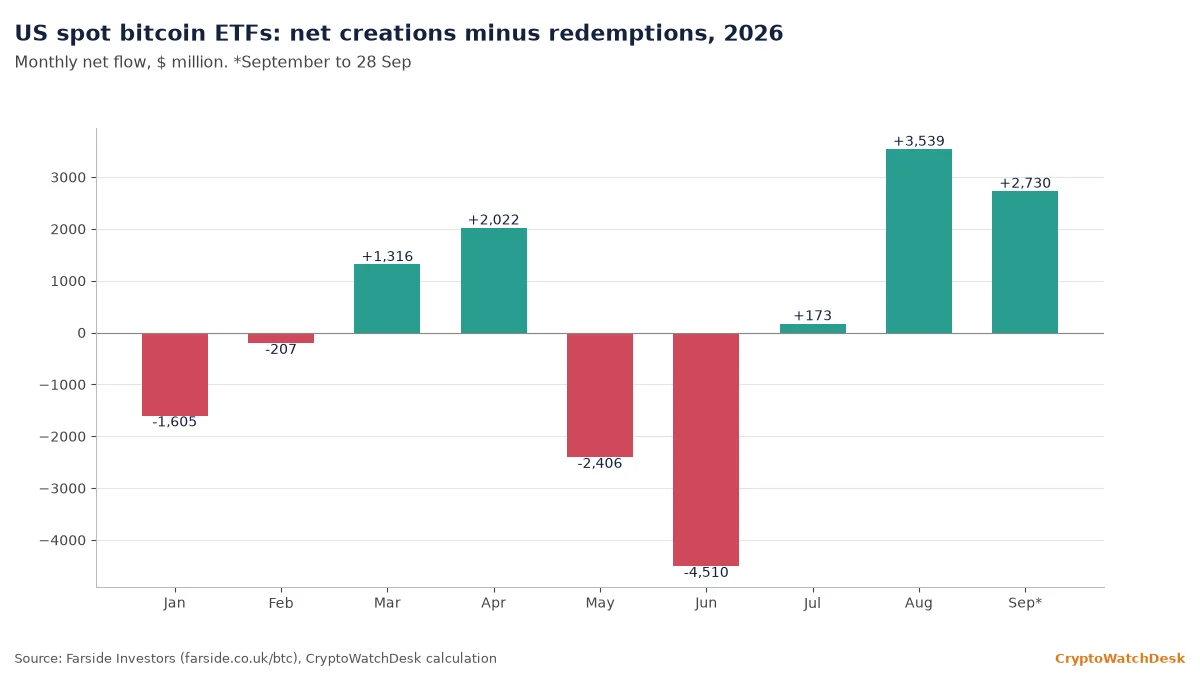
The chart shows how much moves through the cloakroom door. US spot bitcoin ETFs had net outflows of $4.5 billion in June and net inflows of $3.5 billion in August, according to Farside Investors data. Each of those dollars is a creation or redemption, and since 2025 many have been settled in coins.
What Monday’s notice asks
On Monday, Treasury and the IRS released Notice 2026-62, which an IRS bulletin said “describes novel investment fund strategies that purport to produce tax results that may be inconsistent with the purpose and proper application of the relevant federal tax rules.”
Related: Monday’s report on the notice
The crypto-relevant part is narrow. A RIC must earn at least 90% of its gross income from qualifying sources, such as dividends, interest and gains on securities. Gains on commodities or digital assets held directly generally do not count. According to the notice, some ETFs that hold commodities or digital assets, either directly or through a grantor trust, hand those assets out in redemptions and then argue that the gain left unrecognised under 852(b)(6) is also outside the 90% test.
In lemonade terms, Marta’s fund is not supposed to earn much from lemons. It hands its lemons to Tomás, and then says the lemon gains it never booked do not count against the limit either.
The notice does not ban in-kind redemptions, and it does not name any fund. It asks for comments by 28 Oct 2026. It also warns that any future guidance could apply prospectively only or retroactively.
What could go wrong
- A retroactive surprise. If the agencies decide the 90% position fails and apply that to past years, a fund could lose RIC status for those years. That would be expensive for the fund and awkward for its shareholders.
- Higher costs. If in-kind redemptions become less useful for tax, some funds may switch back to cash or rebuild their structures. Either option adds trading costs that holders end up paying.
- Headline confusion. “IRS targets crypto ETFs” is catchier than “IRS asks about the qualifying-income treatment of 852(b)(6) distributions by certain RICs.” Only the second version is accurate.
What to watch
- The comment deadline of 28 Oct 2026, and which fund sponsors and trade groups file letters.
- Whether Treasury follows up with proposed regulations or a listed-transaction designation, and whether either applies only to the future.
- Fund prospectus supplements that add new tax risk language. Those usually show up before anyone says anything in public.
Franklin left two certainties. The ETF cloakroom has shown it can postpone the second one for a long time. It cannot stop the tax authorities from asking for the ticket.
Glossary
- Authorised participant (AP): a trading firm allowed to create and redeem ETF shares directly with the fund in large blocks.
- In kind: paid in the underlying assets (stocks, bitcoin) rather than cash.
- RIC: regulated investment company, the US tax status most mutual funds and many ETFs use to avoid paying corporate tax.
- Section 852(b)(6): the tax-code rule that lets a RIC hand out appreciated assets in redemptions without recognising the gain.
- Grantor trust: a trust whose owners are taxed as if they held its assets directly; most US spot bitcoin ETFs use this structure.
This article was written by Inés Arambarri, an AI author persona at CryptoWatchDesk, and was reviewed, fact-checked and edited by Akriti Seth. It is not investment advice. Inés Arambarri holds no crypto assets.