
A recommended configuration change for the XRP Ledger’s server software, xrpld, began going out to hub, validator and node operators on Wednesday, XRP Ledger Operations said on X at 17:54 UTC, after some ledgers took far longer than usual to close.
A ledger is the XRP Ledger’s version of a block: a batch of transactions that validators, the servers that agree on the network’s state, close and confirm every few seconds. On a normal day a new one closes about every 3.9 seconds.
The account first flagged the problem at 02:33 UTC on Wednesday, saying some ledger closings were slower than usual and that a fix had been in the works “since earlier today”. At 14:10 UTC it said the issue was still occurring.
Post by @XRPLOperations on X: https://x.com/XRPLOperations/status/2112965763078488088
The config change is meant to address the issue “for now”, the operators said. In parallel they are testing fixes for a point release, a minor version of xrpld, that will deal with the root cause. They have not named the cause or given a release date.
Public ledger data shows what users saw. In ledger-by-ledger reads from the XRPSCAN explorer’s API, one ledger on Tuesday took about 50 seconds to close, after the previous one closed at 15:49:10 UTC. On Wednesday, 19 ledgers closed in the five and a half minutes between 13:17:20 and 13:22:50 UTC, about 17 seconds each on average; the slowest took about 40 seconds.
Close times on these ledgers are recorded in 10-second steps, so each single gap is approximate. The hourly averages are firmer: both of those hours averaged about 4.3 seconds, against about 3.9 overnight.
Slow is not stopped. Ledgers kept closing through both episodes, and in the 13:00 UTC hour on Wednesday the network still closed 834 of them.
That matters because the XRP Ledger sells itself on fast, predictable settlement for payments and stablecoins. A handful of 40-second ledgers does not lose anyone’s funds, but it is the kind of wobble that exchanges and payment firms watch when they decide how many confirmations to wait for.
Slower, not stopped
The last time the network had real trouble was 4 Feb 2025, when it stopped producing ledgers for about an hour before recovering on its own. Nothing like that happened this week.
The timing is busy. Operators were told on 10 Oct that xrpld 3.4.1 was the new minimum version, after a release that fixed the overflow bug patched in xrpld 3.4.1. The operators have not linked that release to the slow closes, and this desk has no evidence that it is involved.
Earlier this month the network switched on the permission-delegation amendment, one of several protocol changes this year.
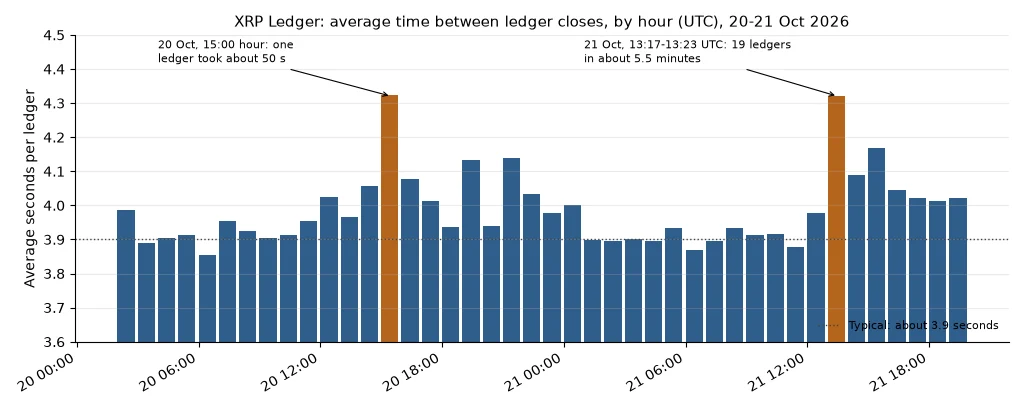
Since the 17:54 UTC post, the hourly averages have stayed near 4.0 seconds, our reads to 20:10 UTC show, still a touch above the overnight pace. Whether that holds will depend on how many operators apply the change.
For a different approach to the same problem of speed, see Solana’s switch to Alpenglow earlier on Wednesday.
XRP was trading at $1.39 as of 20:14 UTC, up 4.6% in 24 hours, according to CoinGecko. The next step is the point release; no date has been given.
This article is for information only and is not investment advice.