“Inflation is always and everywhere a monetary phenomenon.” — Milton Friedman, Inflation: Causes and Consequences, 1963
Every school has two kinds of report.
There is the grade read out in assembly, the one everyone hears and the parents discuss over dinner. Then there is the transcript in the office filing cabinet, the one the scholarship committee actually uses.
In US inflation, the Consumer Price Index (CPI) is the assembly grade. The Personal Consumption Expenditures price index, PCE inflation for short, is the transcript.
Bitcoin traders have learned to read the transcript.
What PCE inflation measures, with a grocery basket
Say Ana does the weekly shop for her family in Ohio.
CPI asks a fixed-ish question: how much more does Ana pay this month for roughly the same basket she bought before? It counts what urban households pay out of their own pockets, and its weights change slowly.
PCE, published by the Bureau of Economic Analysis (BEA), asks a broader one. It also counts spending made on Ana’s behalf, such as the health insurance her employer pays for, or Medicare paying her mother’s doctor. Its weights also shift faster when people change what they buy.
So when beef jumps in price and Ana switches to chicken, PCE notices the switch sooner. Its measured inflation usually runs a little below CPI because of that.
(Ana’s family also notices the switch, but nobody publishes their opinion at 8:30 a.m. Eastern.)
That is why the Federal Reserve prefers it. The Fed began favouring PCE over CPI in its forecasts in 2000, and when it adopted a formal 2% inflation goal in January 2012, it set that goal in PCE terms.
Why a crypto desk cares
Bitcoin does not pay interest, so its price is sensitive to what interest rates are expected to do. If inflation cools, traders tend to price a gentler Fed, and assets that pay nothing look less expensive to hold. If inflation runs hot, the reverse applies.
There is a recent, painful example. US CPI inflation hit 9.1% in June 2022, its highest in four decades. That month the Fed raised rates by three-quarters of a percentage point, its biggest single move since 1994, and bitcoin fell below $20,000 for the first time since late 2020. Crypto had been treated as a tech story. That summer it traded like a rates story, and much of the market has read it that way since.
PCE is the Fed’s own scoreboard, so it can move those rate expectations more than a headline CPI number does. Its release at 8:30 a.m. New York time (12:30 UTC in summer) is one of the few macro moments when crypto desks across time zones watch the same screen.
What happened on Wednesday
The BEA reported that the PCE price index rose 3.4% in the year to August and 0.3% on the month. Excluding food and energy, the “core” index rose 3.0% from a year earlier and 0.2% on the month.
The release also carried BEA’s annual update of the national accounts, with revisions back to January 2021. That makes month-to-month comparisons with earlier headlines less clean than usual, which is a good reason not to read too much into the drop.
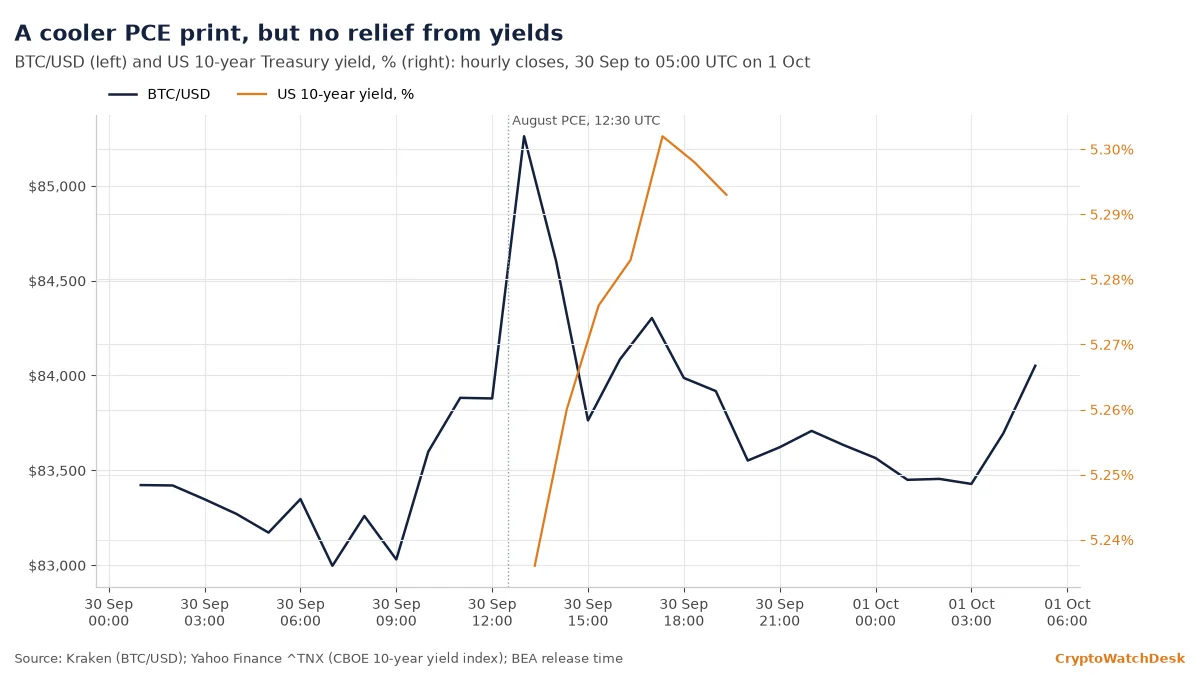
Bitcoin’s first reaction was textbook: it reached $85,604 on Kraken within about 90 minutes of the release. Its second reaction was less textbook.
The 10-year Treasury yield rose over the US afternoon, from about 5.24% to about 5.30%, according to Yahoo Finance’s ^TNX index. Bitcoin slipped back to about $83,550 by 20:00 UTC, inside the range it has held since late September.
Related: Wednesday’s market report
The inflation report helped. The bond market did not.
What could go wrong
- Reading the headline and missing the revision. With an annual update in the same release, last month’s number can change under your feet. Compare like with like.
- Treating one print as a trend. One cool month does not make a cutting cycle. The Fed looks at several months, plus jobs data.
- Ignoring yields. If long-term yields rise anyway, because of government borrowing or term premium, a cool PCE print can still leave financial conditions tighter.
What to watch
- The next PCE release, for September, on 29 Oct 2026 at 8:30 a.m. EDT (12:30 UTC), according to the BEA.
- The Fed’s 27–28 Oct policy meeting, the day before that release.
- The 10-year yield: whether it stays above 5% after a run of softer inflation numbers.
Friedman said inflation is always and everywhere a monetary phenomenon. On Wednesday afternoon, bitcoin traders learned it is also, at 12:30 UTC, a bond-market phenomenon.
Glossary
- PCE price index: the BEA’s measure of prices for everything households consume, including spending made on their behalf; the Fed’s preferred inflation gauge.
- Core PCE: PCE excluding food and energy, which are volatile.
- CPI: the Bureau of Labor Statistics’ consumer price index, based on what urban households pay out of pocket.
- 10-year yield: the annual return on a 10-year US government bond; a benchmark for borrowing costs.
- Annual update: BEA’s yearly revision of past national-accounts data, which can change earlier inflation readings.
Produced by the Crypto Watch Desk newsroom using AI tools. This article is for information only and is not investment advice.