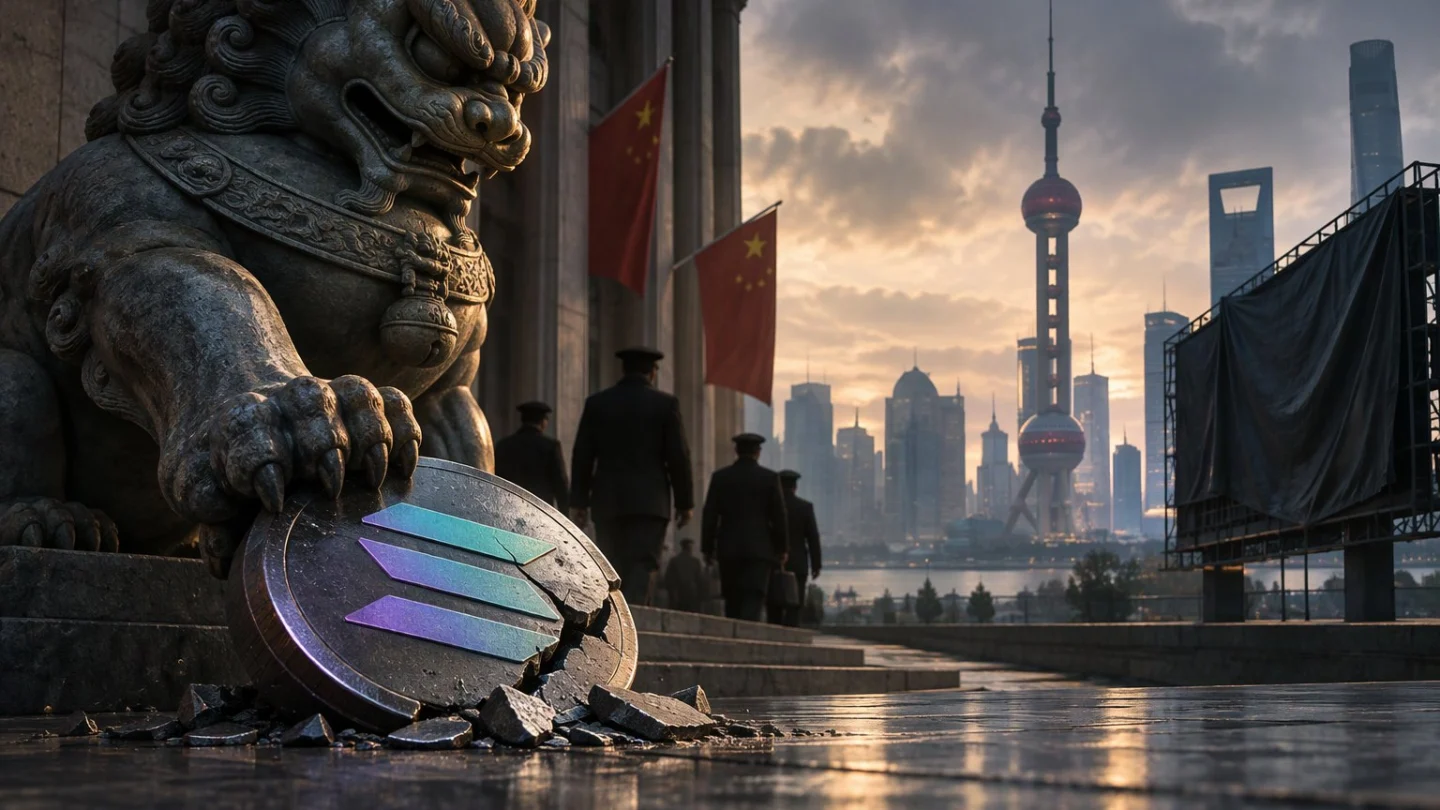
At a glance
- A department head at the People’s Bank of China said Solana Accelerate China 2026, planned for Shanghai and other cities, was halted shortly before it opened, according to remarks carried by state-backed Financial News and relayed by National Business Daily and PANews on Friday 6 Nov.
- The PBoC says it acted with local financial regulators, police and market regulators, and will investigate the entities and individuals involved in Solana’s advertising on a Lujiazui office tower.
China’s central bank has publicly confirmed that it stopped Solana’s mainland events, and it has gone further than a cancelled venue. The unnamed PBoC official said Solana had placed advertising on the outer wall of the Citigroup Tower in Shanghai’s Lujiazui financial district through domestic entities, which the bank treats as virtual-currency marketing.
What the PBoC official said
The official described SOL as “essentially a virtual currency” and said Solana also provides technical services for the issuance and trading of major tokens such as USDT (translated from Chinese). Both activities count as illegal financial activity under China’s notice on preventing and handling virtual-currency risks, the official said; PANews identifies it as the notice issued by eight departments in February. Promoting Solana therefore breaches that notice, according to the official.
The PBoC said virtual currencies cannot yet meet customer-identification and anti-money-laundering requirements and tend to fuel speculation. Next, it plans to work with other departments and local governments to target domestic virtual-currency dealers and the onshore affiliates of offshore issuance and trading platforms, the official said.
This has not been independently confirmed by CryptoWatchDesk against a PBoC website notice; the remarks come from the interview as carried by Chinese media.
How Shanghai got here
The campaign was not quiet. On 14 Oct, Solana’s official X account posted “ni hao shanghai” with footage of its branding lit up in Shanghai. Two days later, Solana Foundation president Lily Liu wrote that registrations had quadrupled overnight after the publicity, far exceeding the cap the team had registered for the event.
Friday’s remarks are the first public account from a regulator of why the events stopped. They also land in a month when Beijing has kept crypto in its political language; see China’s party resolution naming virtual currency in its anti-corruption drive.
Why it matters: the PBoC is signalling that brand marketing by a blockchain network, not only exchange trading, falls inside the mainland ban. Onshore partners of foreign crypto projects are now named as the enforcement focus.
What we don’t know yet
The PBoC did not name which companies or individuals are under investigation, what penalties could follow, or whether other Solana-linked activity in China is affected. We found no public response from the Solana Foundation or Liu on X by about 05:00 UTC on Saturday.
SOL traded near $89.86 on Kraken at 04:43 UTC, inside a 24-hour range of $88.82 to $91.47. We make no link between the price and the PBoC remarks.
Next
Watch for a written PBoC or Shanghai financial-regulator notice, any statement from the Solana Foundation, and whether other offshore networks with mainland marketing face similar action. For the wider policy backdrop, see Beijing’s plan for a national blockchain network by 2030.
Related: The halt of Solana's Shanghai events is the lead item in this week's Asia Ten
This article is for information only and is not investment advice.