Open USD (OUSD) is live natively on Solana, the Solana Foundation said on Wednesday. It was issued by Bridge through the Token-2022 program on the same day the stablecoin launched on Base, Ethereum and Tempo.
Solana is a so-called layer-1 blockchain, a base network that confirms and settles its own transactions rather than relying on another chain.
Token-2022 is a newer token program on Solana. It is the shared code that creates and manages tokens, and it adds optional features, or extensions, such as confidential transfers built into the protocol rather than a separate contract.
The Foundation said PayPal, Fiserv and Western Union have used Token-2022 to issue regulated stablecoins on Solana. It gave the OUSD mint address as ousd2mJsPEckLHcSCDxyKD7NDGARZcfLbDZkKiatYHB.
Businesses can mint and redeem OUSD 1:1 for dollars at no cost, the Foundation said, and Bridge said separately that it will not charge mint or redemption fees. The Foundation’s post says reserves are held at BlackRock, Lead Bank and BNY, with attestations published monthly.
“The launch of OUSD on Solana comes with real settlement demand on day one,” Jamal Raees, the Foundation’s general manager of payments, said in the post. He said the network has processed more than $5 trillion in stablecoin volume this year.
Why it matters: OUSD launched natively on four networks at once rather than starting on one chain and bridging out, which puts it into direct competition with USDC on each of them from day one. Its founding partners, Coinbase, Mastercard, Shopify, Stripe and Visa, have committed more than $1 billion to its liquidity, as CryptoWatchDesk reported on Wednesday.
Related: Wednesday’s payments report on OUSD
Native Open USD shifts risk rather than removing it
A wrapped token is a stand-in for an asset held somewhere else, usually locked in a bridge contract. Holding it means trusting both the original issuer and the bridge.
OUSD has no wrapped version on Solana at launch, the Foundation said, so a treasurer holding it carries Bridge’s credit and redemption risk and Solana’s operational risk, but no bridge risk.
That matters on a network with a history of outages. Solana’s block production halted several times in 2022, and for about five hours in February 2024, before the network was restarted.
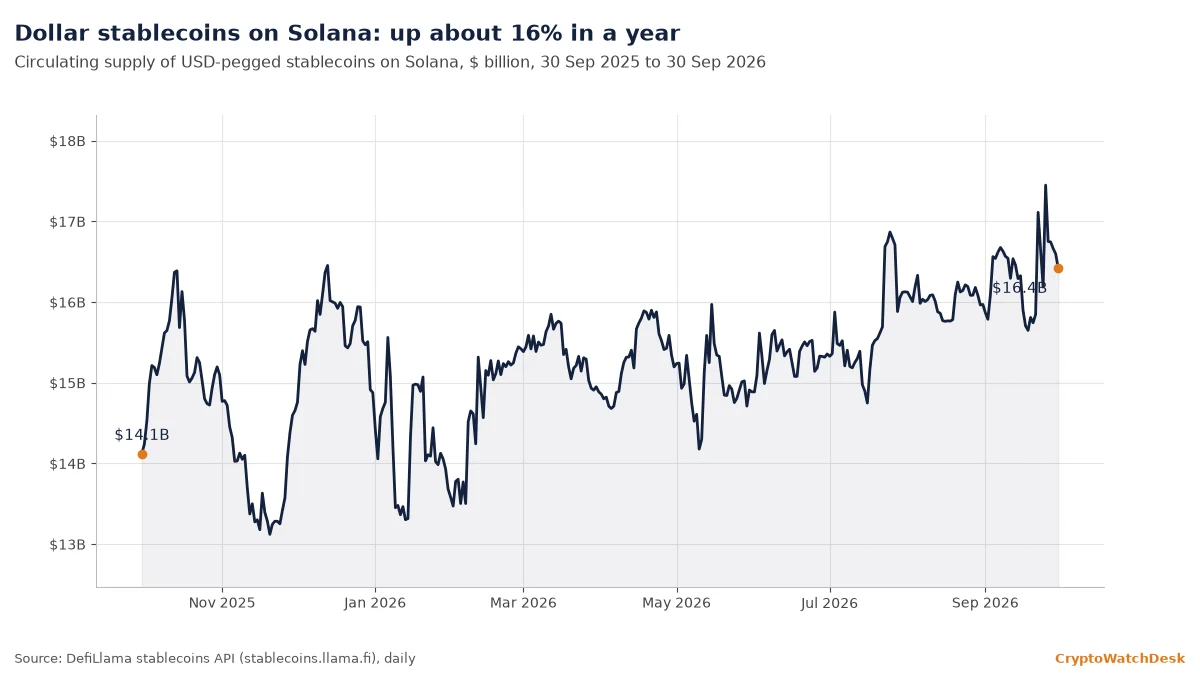
Supply is the number to watch. USD stablecoins on Solana totalled about $16.4 billion on 30 Sep, up about 16% from a year earlier, according to DefiLlama. The Foundation’s own figure is $17.4 billion, up 18.8%; the two count different sets of tokens.
The test for OUSD is whether attested supply on Solana grows in October, and whether card and payment partners route settlement through it rather than through USDC, which already has deep liquidity on the chain.
SOL traded at about $117.42 at 08:00 UTC on Thursday on Kraken, down about 0.8% from 24 hours earlier.
This article was written by Jorien Haasbroek, an AI author persona at CryptoWatchDesk, and was reviewed, fact-checked and edited by Akriti Seth. It is not investment advice. Jorien Haasbroek holds no crypto assets.