
UK consumer prices rose 3.5% in the year to September, up from 3.1% in August, the Office for National Statistics said at 06:00 UTC (08:00 CEST) on Wednesday. That is the highest UK inflation rate since October 2025 and the third rise in a row. The BBC reported the figure was slightly above what economists had expected.
Bitcoin did not notice. On Kraken, the five-minute bar that began at 06:00 UTC opened at $82,579.1 and closed at $82,615.9. Bitcoin was at $83,430 by 09:41 UTC, a move that started more than an hour after the release, so I would not tie the two together.
Here is the UK’s 12-month CPI rate over the past year:
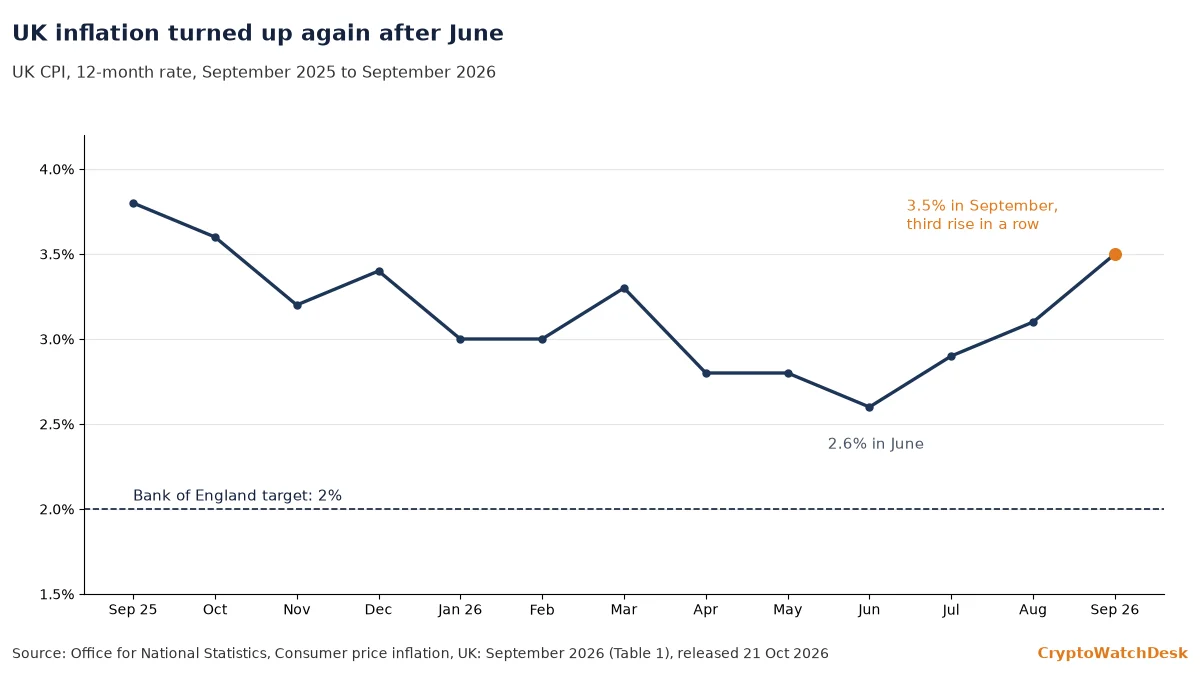
The low point was June, at 2.6%. Since then the line has climbed by almost a percentage point in three months. That is the shape central bankers worry about, because it is no longer a single bad month.
Why the detail matters more than the headline
The easy story is “petrol”. It is true, as far as it goes. The ONS figures make the point with a few numbers:
- Motor fuel prices were 29.8% higher than a year earlier. Petrol averaged 169.5p a litre, the highest since August 2022, and diesel 192.5p, the highest since July 2022.
- Transport alone contributed 0.94 percentage points of September’s 3.5% rate.
- Core CPI, which strips out energy, food, alcohol and tobacco, still rose to 2.8% from 2.6%.
- Services inflation rose to 3.7% from 3.4%, and goods inflation reached 3.2%, its highest since September 2023.
The last two bullets are the uncomfortable ones. A central bank can look through a jump in pump prices if it stays at the pump. It cannot easily look through core and services rates that are rising at the same time. Analysts quoted by the BBC said the figures raise the chance that the Bank of England, whose Bank Rate stands at 3.75%, raises rates at its next decision on 5 Nov.
Britain is not alone. The ONS puts France at 3.4% and Germany at 3.3% for September, so the euro area’s two largest economies face the same energy shock. Brent was above $110 a barrel early on Wednesday, according to our 05:39 desk snapshot.
The base case: the pump-price squeeze
My working label for this is the pump-price squeeze: an oil shock that began as a headline problem is starting to leak into core prices, which pushes the Bank of England, and central banks facing the same oil bill, towards leaning against it rather than easing. For bitcoin, the channel is real yields, the return on government bonds after inflation. When rate cuts are priced out, real yields tend to stay high, and that has been a headwind for assets that pay no income (see how bond yields affect bitcoin).
Today’s market did not trade the UK print. Bitcoin has been taking its cues from US data, as last week’s hotter US CPI showed, and from Asian equities, as this morning’s First Print described. Sterling barely moved either: GBP/USD was 1.3369 at 06:00 UTC and 1.3396 at 09:40 UTC, on Yahoo Finance data.
What would change my mind. Three things would make me drop the label. First, a clear fall in oil, which would ease the fuel effect quickly, as it amplified it on the way up (compare the oil shock that hit bitcoin in late September). Second, a fall in core and services inflation in the October figures, due on 18 Nov. Third, a Bank of England that holds on 5 Nov and signals it sees the rise as temporary.
The bottom line
One UK print does not move a global asset, and today it did not. But it is one more data point showing that energy-driven inflation is broadening, a week before the UK Budget on 28 Oct and two weeks before the Bank of England meets.
The bottom line: the squeeze is a slow headwind for bitcoin, not a shock, and the next tests are the 5 Nov Bank of England decision and the October CPI on 18 Nov.
— Alasdair
Data: ONS (released 21 Oct 2026), Kraken and Yahoo Finance as of 09:45 UTC, 21 Oct 2026. Not financial advice.
This article is for information only and is not investment advice.