
Key points
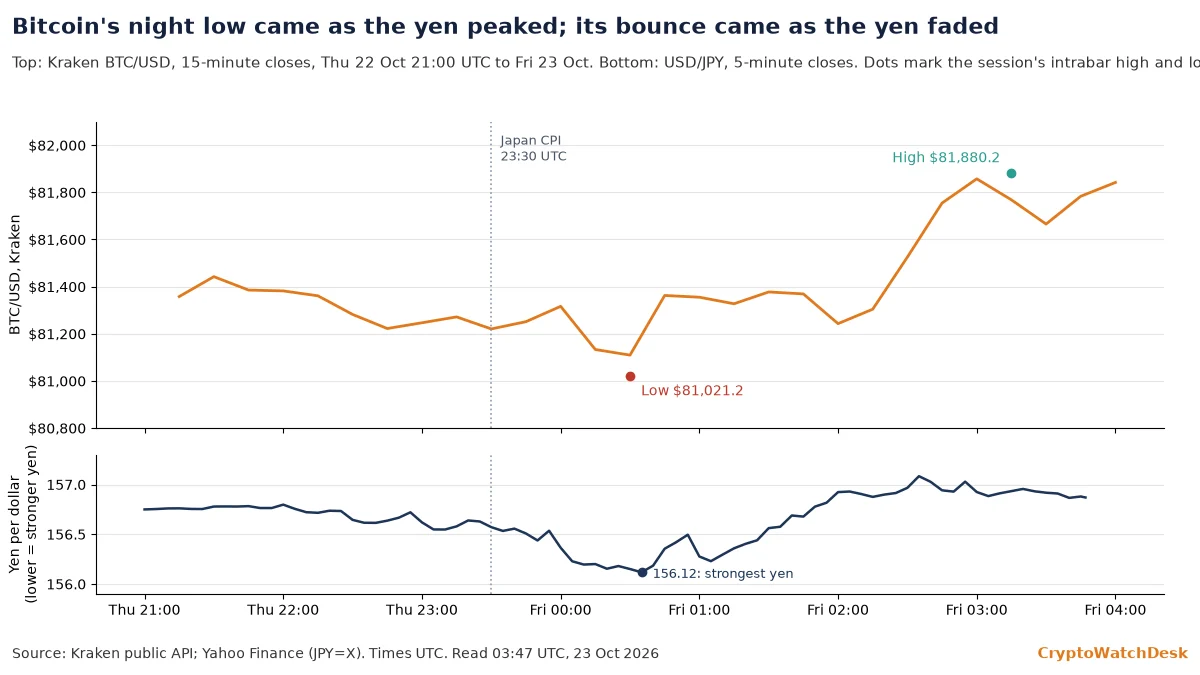
- Japan’s core inflation rose to 2.1% in September from 1.7%, its first reading above 2% in nine months. The yen strengthened to 156.07 per dollar, then fell back towards 157.
- Bitcoin dipped to $81,021 on Kraken just after midnight UTC and climbed to $81,880 by 03:00 UTC. It was near $81,855 at 03:49 UTC, with Coinbase at $81,858.
- US spot bitcoin ETFs lost a net $635.6 million on Thursday. Our $84,250 rule keeps the market mood at Bearish.
The yen had the busiest night of any market we watch. Bitcoin had one of its quietest.
Bitcoin traded near $81,855 on Kraken at 03:49 UTC, 0.7% above the UTC-day open of $81,314. Ether was near $2,411, solana near $104.21 and XRP near $1.321.
From 21:00 UTC on Thursday to 03:49 UTC, bitcoin’s whole range was $859. As how Thursday ended showed, the bigger move came earlier, when the Nasdaq’s AI sell-off took bitcoin to $80,814.
Tokyo’s numbers moved the yen first
Japan’s core consumer prices, which leave out fresh food, rose 2.1% in September from a year earlier, up from 1.7% in August, according to government data reported by Reuters via Nikkei Asia. The reading matched the median forecast.
The gauge that also strips out fuel rose 2.4%, from 1.9%. The Bank of Japan watches that one more closely for demand-driven price pressure.
Goods prices rose 2.8% and services 1.5%, both faster than in August, Reuters reported. Rice prices fell 20.6% from a year earlier, CNBC reported.
The central bank raised its policy rate to 1.25% in September. Its next meeting ends on 30 Oct, and sources told Reuters it is set to hold then.
The data came out at 23:30 UTC. The dollar slid from about 156.6 yen to 156.07 at 00:35 UTC, the yen’s strongest level since 18 Sep, CoinDesk reported. By 02:40 UTC it was back at 157.12.
Bitcoin’s low, $81,021, came in the 00:15 UTC bar. Its climb began after 02:00 UTC: the 02:30 bar ran from $81,525 to $81,754 on about 32 BTC, the busiest quarter-hour of the night.
That is timing, not proof. A stronger yen raises the cost of the cheap-yen borrowing that funds some risk trades, which is why traders watch it. The bounce also lined up with Nasdaq 100 futures recovering from 29,023 to about 29,173.
Seoul had a rougher morning. The Kospi fell as much as 4.1% before trimming the loss to 1.8% at 5,436.54 by 03:29 UTC. Japan’s Nikkei 225 was down 1.1% and Shanghai 1.2%, while Hong Kong’s Hang Seng rose 0.6%.
Gold was near $4,032 an ounce, 0.7% lower, after an early low CoinDesk put at $3,986, the lowest since 29 Jul. Brent crude was near $113.65 a barrel and the dollar index near 101.65.
The US 10-year yield closed Thursday at 4.95%, down from 5.15%. Our guide on how bond yields move bitcoin explains why that matters for an asset with no coupon.
Derivatives: longs paid for Thursday
About $435 million of crypto futures positions were liquidated over 24 hours, $385 million of them longs, CoinDesk reported.
Funding stayed mildly positive. Deribit’s bitcoin perpetual showed 0.005% per eight hours; OKX showed 0.008% for the current period after 0.0067% last settled.
Put simply, funding is the periodic payment between long and short holders of a perpetual future; small and positive means longs pay a little to keep their bets open.
Deribit perpetual open interest was about $825 million, down from $837 million on Thursday morning. The DVOL index read 37.76, which implies a typical daily move of about 2%. The night’s range was about half of that.
Bitcoin’s share of total crypto market value was 59.5% on CoinGecko.
US spot bitcoin ETFs lost a net $635.6 million on Thursday, Farside data show.
BlackRock’s IBIT lost $254.1 million, Fidelity’s FBTC $217.5 million and ARK’s ARKB $109.4 million. Ether funds lost $110.6 million. That reverses most of Wednesday’s $524.8 million inflow, covered in ETF Desk: Wednesday’s flows.
The level to watch is $81,880, the overnight high. Acceptance above it reopens $82,543, Wednesday’s low, then $84,250. A sustained break below $81,021, the overnight low, would bring Thursday’s $80,814 low back into view.
A different reading
The yen may be a coincidence. Bitcoin had already fallen more than $2,000 on Thursday and sellers may simply have been spent by Asia’s open.
Read that way, the bounce is a pause after liquidations, and Thursday’s ETF outflow is the number that matters for the US open.
Respect the range until $84,250 is back.
Chart to watch
- The lead chart: bitcoin’s low within 20 minutes of the yen’s peak, and its climb as the yen faded.
- Overhead: $81,880, the overnight high, then $82,543, Wednesday’s low, then $84,250, the 12 Oct high and our flip line for the market mood.
- Below: $81,314, the UTC-day open, then $81,021, the overnight low, then $80,814, Thursday’s low.
On the calendar (UTC / CEST)
- Fri 23 Oct, 08:00 UTC (10:00 CEST): Deribit weekly options expiry.
- Thu 29 Oct to Fri 30 Oct: Bank of Japan policy meeting, ending 30 Oct, per Reuters via Nikkei Asia.
Also see Thursday’s First Print, written as Asia’s sell-off took bitcoin below $83,000.
As of 03:49 UTC (05:49 CEST), bitcoin was trading near $81,855 on Kraken and ether near $2,411. This is market commentary, not financial advice.
Related: Thursday US close: the Nasdaq slid and bitcoin hit a new day low
Related: J.P. Morgan brings its tokenized money market funds to Solana
Related: ETF Desk: the 22 Oct fund flows in full
This article is for information only and is not investment advice.