

Bitcoin’s market has gone quiet.
The decline fits a longer trend. Fidelity Digital Assets has noted that Bitcoin’s realized volatility has consistently fallen as the asset has grown, pointing out that there has never been another period when Bitcoin’s market cap exceeded $500 billion while its one-year realized volatility remained below 50%. iShares has made a similar observation, noting that while Bitcoin remains far more volatile than gold and global equities, that gap has been narrowing steadily.
Live market chartBTCUSDShow chartHide chart
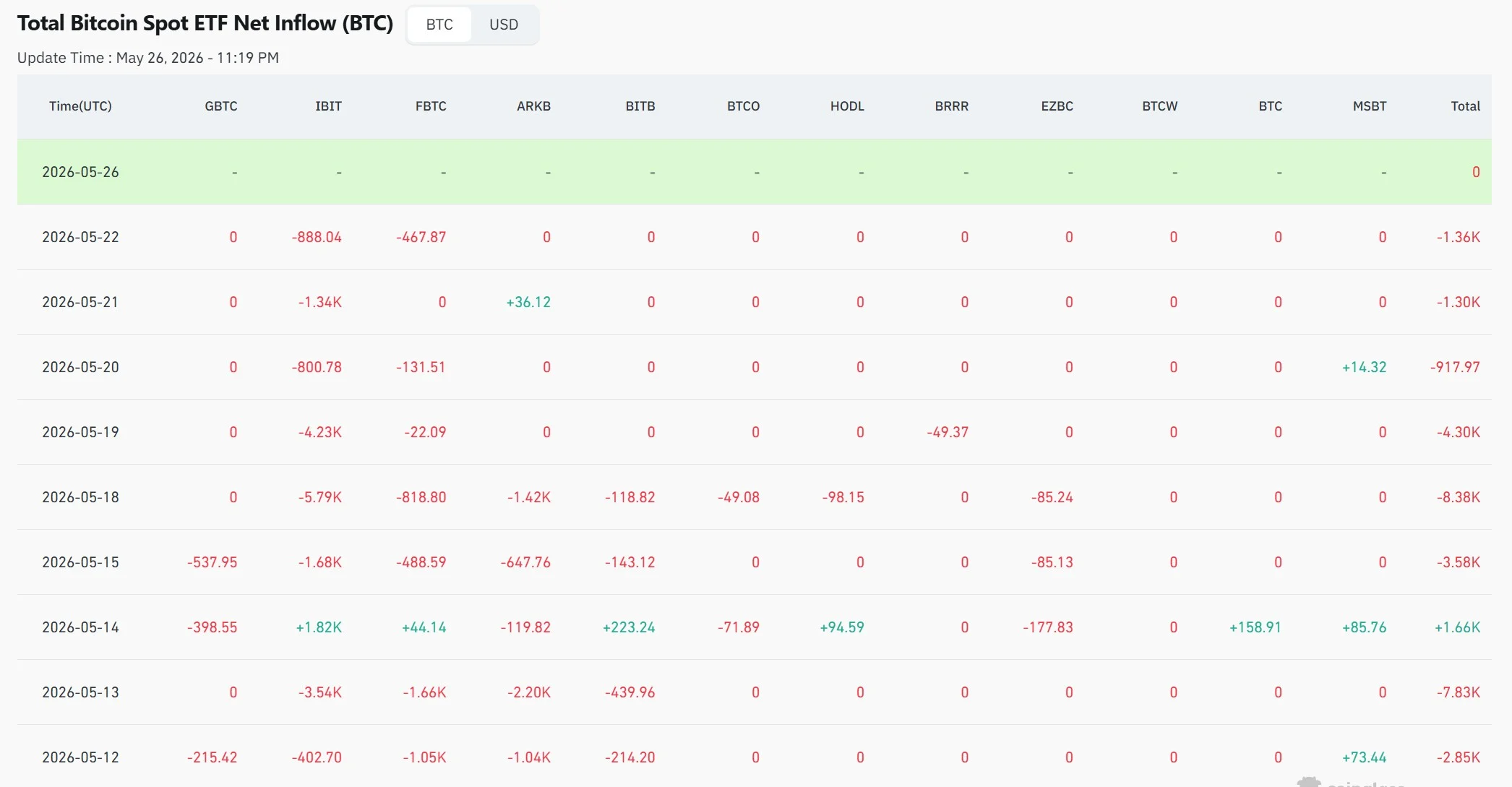
Implied volatility has dropped to a nine-month low just as US spot Bitcoin ETF outflows mount to roughly $1 billion in May, reversing two months of net inflows and removing one of the most reliable engines of recent demand.
The Bitcoin Volmex Implied Volatility Index (which measures expected 30-day price swings using real-time crypto options pricing) fell to 36.11 on Monday during Asian trading hours, its lowest reading since September and near its lowest point since 2023.
Read More: Bitcoin Must Clear $80,000 to Exit Bear Market, Analyst Warns | Crypto Watch Desk
Volatility Hits a Multi-Year Milestone: ETF Outflows Add Pressure
The current calm is not only a product of long-term maturation. US spot Bitcoin ETFs,which launched in early 2024 and quickly became a primary channel for regulated exposure to the asset, recorded approximately $1 billion in net outflows in May.
The outflows accelerated sharply in one week, reaching minus $594.3 million, with BlackRock posting the largest single distribution at minus $423.9 million.
Saylor Repurchases $1.5B of Debt
For years, Michael Saylor had one rule: buy Bitcoin and never sell. Strategy (NASDAQ: MSTR), the company he chairs, became the largest corporate Bitcoin holder in history by following that rule without exception. But something shifted in the past two weeks. Saylor bought bonds instead of Bitcoin.
Strategy had been buying BTC almost every week through 2025 and into 2026, sometimes spending billions at a time. The purchases became so predictable that followers looked for Saylor’s Sunday “Orange Dot” posts on X as a heads-up signal before each buy.
Then came the Q1 2026 earnings call on 5 May 2026. Saylor told investors Strategy might “probably sell some bitcoin to pay a dividend just to inoculate the market.” It was the first time he had publicly suggested selling Bitcoin.
On 24 May 2026, he confirmed the shift, posting that Strategy had “bought bonds, not bitcoin” that week.