



Spot bitcoin ETFs recorded net redemptions of close to $1 billion in the week ending 16 May 2026, ending a six-week inflow streak that had drawn $3.4 billion into the products.
The sell-off arrived after one of the stronger stretches for bitcoin ETF demand in recent months. In late April, US-listed spot bitcoin ETFs posted seven consecutive inflow days totaling $1.9 billion, with BlackRock's iShares Bitcoin Trust (IBIT) accounting for more than 73% of that total, roughly $1.4 billion.
The mood shifted quickly in mid-May.
A US producer price index (PPI) report showed the fastest annual rise since 2022, prompting traders to reconsider how soon the Federal Reserve might cut interest rates.
The reversal was driven by a surprise inflation reading, a sharp rise in bond yields, and a broad risk-asset pullback across global markets.
$635.23 million Outflow from bitcoin ETFs in a single session
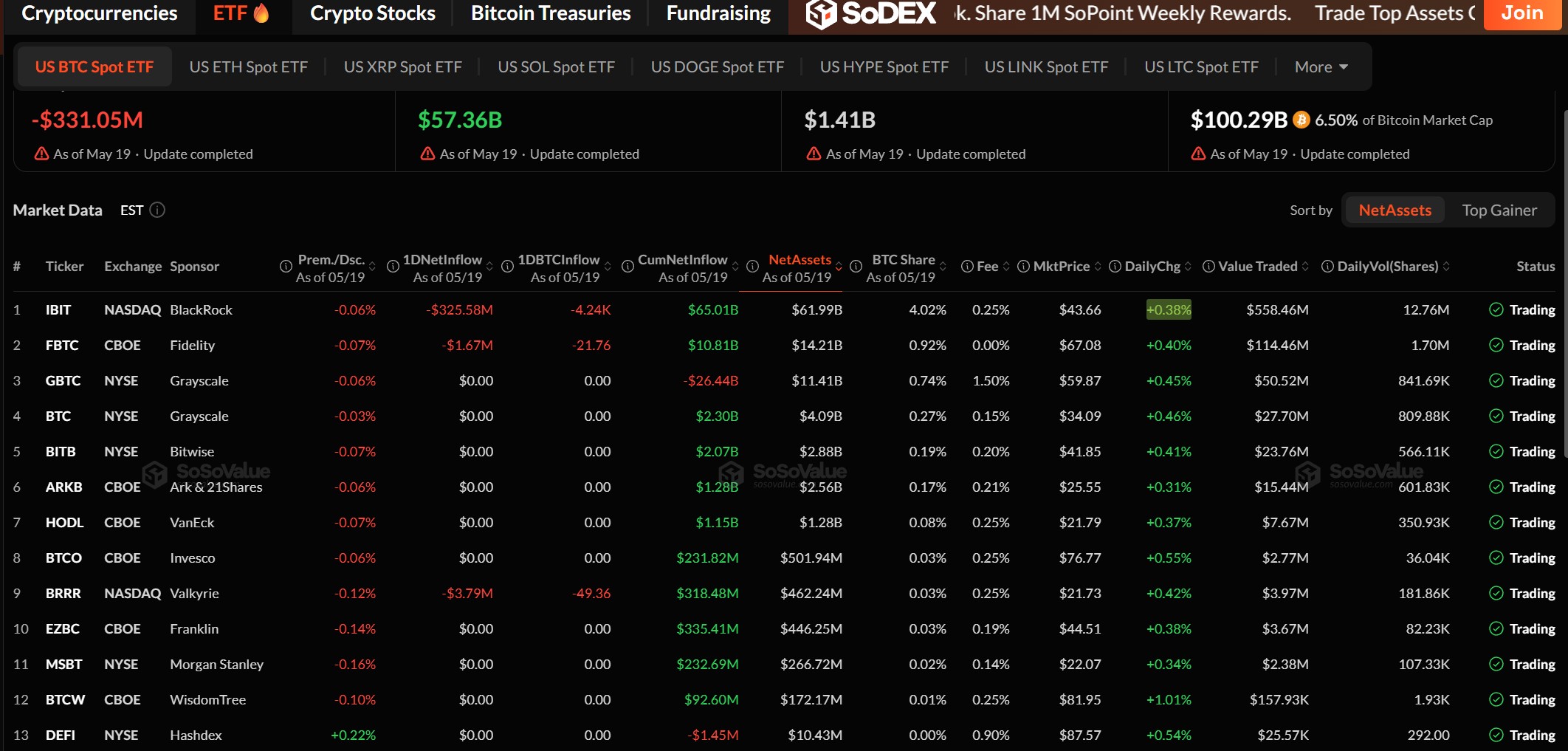
Wednesday was the hardest hit, with $635.23 million leaving bitcoin ETFs in a single session, one of the largest daily redemption totals since the products launched in January 2024.
Thursday saw a brief reversal, with $131.31 million flowing back in, but the rebound did not hold. Friday brought another $290.42 million in outflows as a global bond sell-off pushed the US 10-year Treasury yield above 4.5% and pushed bitcoin toward $78,000.
The Nvidia-Bitcoin Connection
Bitcoin moved back above $77,000 on Wednesday as crypto traders focused on Nvidia's fiscal first-quarter earnings report, treating the chipmaker's results as a key indicator for AI spending momentum and broader risk appetite. The recovery highlights how tightly Bitcoin now trades alongside major technology stocks, with Nvidia's performance seen as capable of shaping sentiment across high-beta markets.
Nvidia is scheduled to report fiscal Q1 2027 results after the US market close on Wednesday, 20 May 2026, with a conference call at 5:00 PM ET. Wall Street consensus expectations center around $78 billion in revenue and $1.77 in non-GAAP earnings per share, though some bullish estimates reach above $80 billion. More critically, analysts are watching for second-quarter guidance in the $85-87 billion range, with whisper numbers closer to $90 billion.
While Nvidia has no direct operational link to Bitcoin or blockchain technology, the two assets have become increasingly correlated through trader behavior and macro sentiment. Nvidia sits at the center of the AI infrastructure trade, and strong earnings typically signal that large-scale technology spending remains robust. That environment tends to broadly support speculative assets, including Bitcoin and AI-themed crypto tokens.
The relationship is primarily psychological rather than fundamental. When Nvidia beats expectations and raises guidance, investors often interpret it as confirmation that growth momentum is intact, supporting appetite for high-volatility assets. Conversely, a disappointing report can trigger broader de-risking, pulling down both tech stocks and crypto.