

Crypto Wallet Security: A Practical Guide to Protecting Your Assets
Most crypto losses aren't from sophisticated hacks — they're from a handful of avoidable mistakes. This guide covers the security fundamentals that protect against 95% of real-world threats.
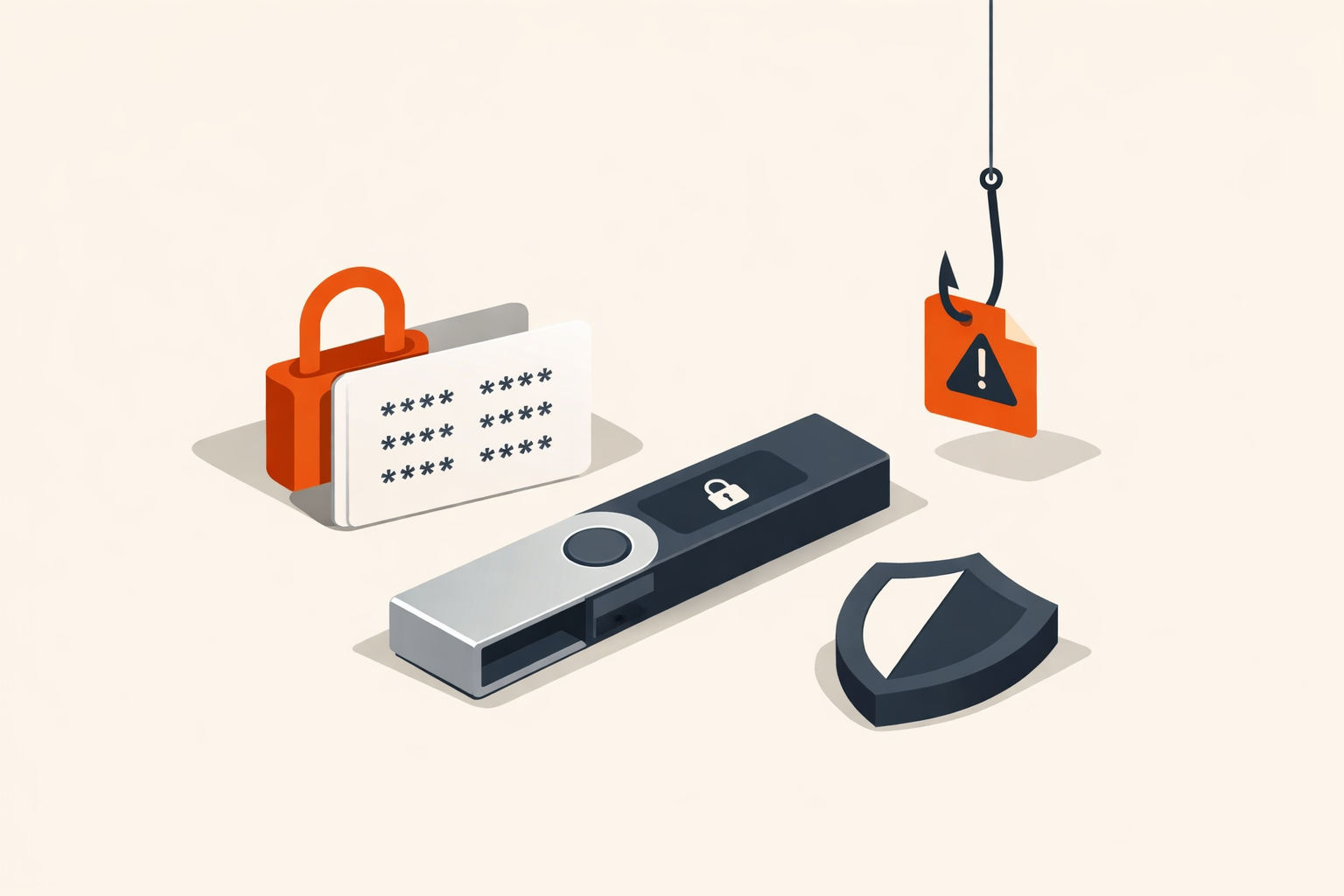
The single most important fact about cryptocurrency security is uncomfortable: most losses are not the result of attacks on cryptography or smart contracts. They're the result of users making predictable mistakes — losing seed phrases, signing malicious transactions, falling for impersonation. The good news is the same: a small number of habits eliminates most of the risk.
Threat Model: What You're Actually Defending Against
Before you choose a security setup, understand what you're protecting against. The realistic threats, ranked by frequency:
- Phishing — fake websites, fake support staff, fake airdrops
- Malicious transactions — signing something that looks normal but drains your wallet
- Lost seed phrases — destroying or misplacing the only backup
- Device compromise — malware on your phone or computer
- Physical theft — rare but increasing for high-profile holders
State-level attackers and zero-day exploits exist but are not the marginal risk for most people. Phishing is.
The Seed Phrase: Your Single Point of Failure
Your wallet's seed phrase (12 or 24 words) is the master key. Anyone with it has full access to your funds. There is no support, no recovery, no override. The rules:
- Write it on paper or stamp it into steel. Never digitize it.
- Never type it into a website — legitimate wallets never ask you to.
- Store it physically in two locations if the holdings justify it (home + safety deposit box).
- Test recovery before you need it — practice restoring from your backup with a wallet that has $5 in it.
If your seed phrase ever leaves the physical world — typed, photographed, emailed, screenshotted — assume it's compromised and move funds to a new wallet.
Hardware Wallets: When and Why
For meaningful holdings (anything you'd be sad to lose), a hardware wallet is the standard. A hardware wallet keeps private keys on a dedicated device and signs transactions internally, so even a compromised computer can't extract the keys. Buy directly from the manufacturer — never used or from a third-party marketplace.
Setup Tips
- Initialize the device yourself; never use a wallet that came with a "pre-configured" seed.
- Always verify the receive address on the device screen, not the computer screen.
- Set a PIN that's long enough to deter physical brute force (8+ digits).
- Consider the optional "passphrase" feature for plausible-deniability storage of large amounts.
Recognizing Phishing
Phishing has gotten very good. Common patterns:
- "Customer support" via DM — Discord and Twitter support reps don't initiate DMs. Ever.
- Urgent emails about account suspension — log in directly, never via the email link.
- Fake browser extensions — verify the publisher and download counts before installing.
- Lookalike URLs — `uniswap-app.com` is not Uniswap. Bookmark the real ones.
- Free airdrops — if a token shows up in your wallet, do not interact with it; the contract may be malicious.
Reading What You're Signing
Modern wallets show transaction details before you sign. Read them. The signature request should match the action you're taking. If you're swapping ETH for USDC and the request says "approve unlimited spend of USDT," cancel it.
For complex transactions, paste the contract address into a block explorer to confirm it matches the dApp's published address. Tools like Wallet Guard and Pocket Universe simulate transactions before you sign and flag suspicious calls.
Operational Habits
- Use a separate wallet (with separate seed) for risky DeFi experiments.
- Revoke token approvals you don't use anymore (revoke.cash makes this easy).
- Don't reuse passwords. Use a password manager.
- Enable hardware-key 2FA (YubiKey) on exchange accounts; SMS 2FA can be SIM-swapped.
- Keep your largest holdings on cold storage, behind a passphrase, with the seed split across two physical locations.
None of this is exotic. It's the financial equivalent of locking your door, looking before you cross the street, and not handing your wallet to strangers. Most people who lose crypto skipped one of these basic steps.