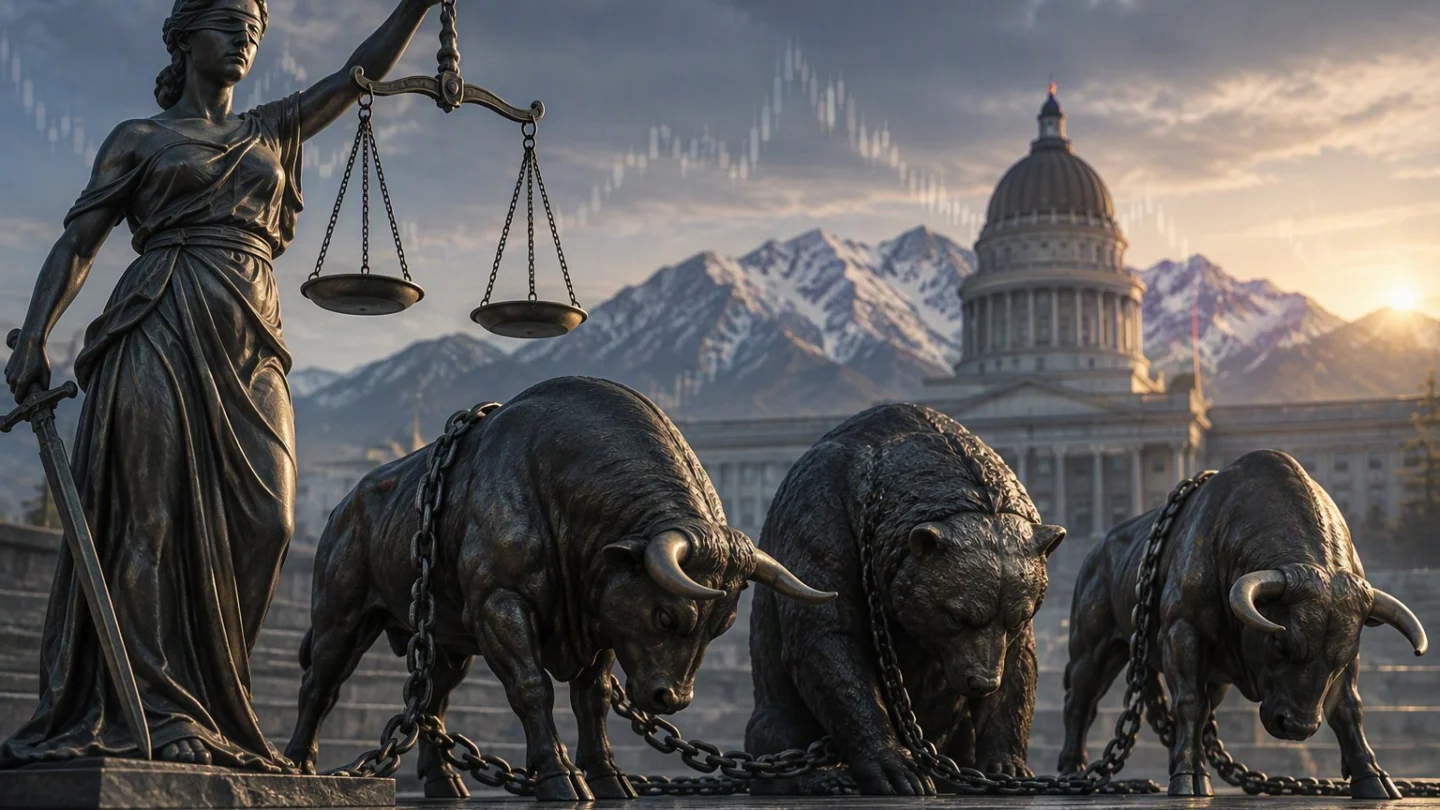
At a glance
- Utah Attorney General Derek Brown sued five Kalshi entities and two Susquehanna trading firms in state court on Tuesday, 20 Oct, alleging the prediction market runs an illegal gambling business in Utah, the complaint shows.
- By the state’s estimate, Kalshi’s fees on Utah accounts came to $30.6 million to $61.2 million through 19 Oct. It wants a court order barring sports, election and similar contracts in Utah, enforced by a court-approved geolocation provider.
The verified complaint was filed in the Third Judicial District Court for Salt Lake County. It names Kalshi Inc., KalshiEX LLC, Kalshi Klear Inc., Kalshi Klear LLC and Kalshi Trading LLC, plus Susquehanna International Group and Susquehanna Government Products. Kalshi did not immediately respond to a request for comment, Utah News Dispatch reported.
What the state alleges
Utah’s constitution bans gambling. The complaint argues that calling a wager an “event contract” does not change what it is, and that Kalshi plays the role of a sportsbook by holding bettors’ funds, paying winners and keeping a fee.
The Susquehanna firms are in the case as market makers. Susquehanna Government Products became Kalshi’s first dedicated institutional market maker on or around 3 Apr 2024, the complaint says, and it alleges the firm takes the other side of retail bets, including from Utah residents. Kalshi Trading LLC plays a similar role, according to the filing.
The fee estimate is the state’s own arithmetic. The complaint puts Kalshi’s charge at $0.01 to $0.02 per wager and estimates more than 3 billion wagers from Utah accounts over the platform’s life, assuming Utah’s share has stayed constant. An exhibit from the earlier federal case quotes Kalshi saying it had more than 32,000 verified users in Utah.
“Utah has said no to gambling since statehood in 1896, and that didn’t change when betting moved onto cellphones,” Brown said at a news conference, according to Utah News Dispatch.
The claims and the ask
The complaint brings claims for public nuisance, unjust enrichment, civil conspiracy, a declaratory judgment and an injunction. It asks for restitution, disgorgement of what the companies earned in Utah, punitive damages and a jury trial. None of the allegations has been tested in court.
The federal case behind it
Kalshi sued Utah first, early this year. KalshiEX argued that the Commodity Exchange Act gives the Commodity Futures Trading Commission (CFTC) exclusive say over its contracts, so state gambling law cannot reach them. Lawyers call this preemption: a federal law that covers a field displaces state rules within it.
US District Judge Robert Shelby rejected that argument in August, KSL reported, denying Kalshi a preliminary injunction and granting the state summary judgment, as Utah’s appeal brief describes the ruling.
On 8 Sep, a two-judge panel of the Tenth Circuit denied Kalshi’s motion for an injunction while it appeals. That leaves Utah free to enforce its law for now; the appeal itself is still pending.
Other states are pressing the same point. Connecticut and Baltimore sued Kalshi in August, The Block noted, and two exchanges sued Missouri last week to block a similar crackdown, as CryptoWatchDesk reported in Crypto.com and Novig’s suits against Missouri.
What happens next
The defendants must now answer the complaint in state court; the complaint already asks for a preliminary injunction. The Tenth Circuit has not said when it will rule on the preemption appeal, and that ruling could bear on the state case. Federal rulemaking could change the picture too: see the CFTC’s event-contract proposal and, for the Supreme Court fight, the NFL’s amicus brief against Kalshi.
This article is for information only and is not investment advice.