SECURITY ALERT · UPDATE
In October it was one report.
Now it is three devices.
Trezor says three of its Safe 5 hardware wallets bought from CryptoBilis contain a hidden implant that copies the recovery phrase, according to an investigation update on Trezor’s blog on Thursday.
Its lab examined one of them, the device reported in October. The other two were identified from photos their owners sent.
None of the three owners has lost funds, Trezor says. No customer has reported a loss.
The purchases date from 20 August to 23 September 2026. They were made through CryptoBilis’s shops on the Indonesian marketplace Tokopedia and on Shopee, or directly from the seller.
What changed this week
On 11 November Trezor released firmware 2.13.1, which its changelog lists for that date.
Trezor says the update stops the implants it has found from capturing anything on a device that runs it. In its words, it makes “the current batch of implants useless”.
A Trezor spokesperson told Protos that the implant waits for a specific sequence of commands between the device’s processor and its display, and that the update changes the order of those commands without changing what appears on screen.
The update protects what happens next. It does not undo what already leaked.
The company has also cut its reseller network by about 80%. It says the sellers it dropped “were trustworthy and posed no immediate threat”, but could not meet stricter rules on where devices come from, how they are stored and who can handle them.
If a phrase was captured in September, what does a firmware update in November change for that wallet?
How the implant works
Trezor’s embedded team extracted and analysed the implant’s own firmware.
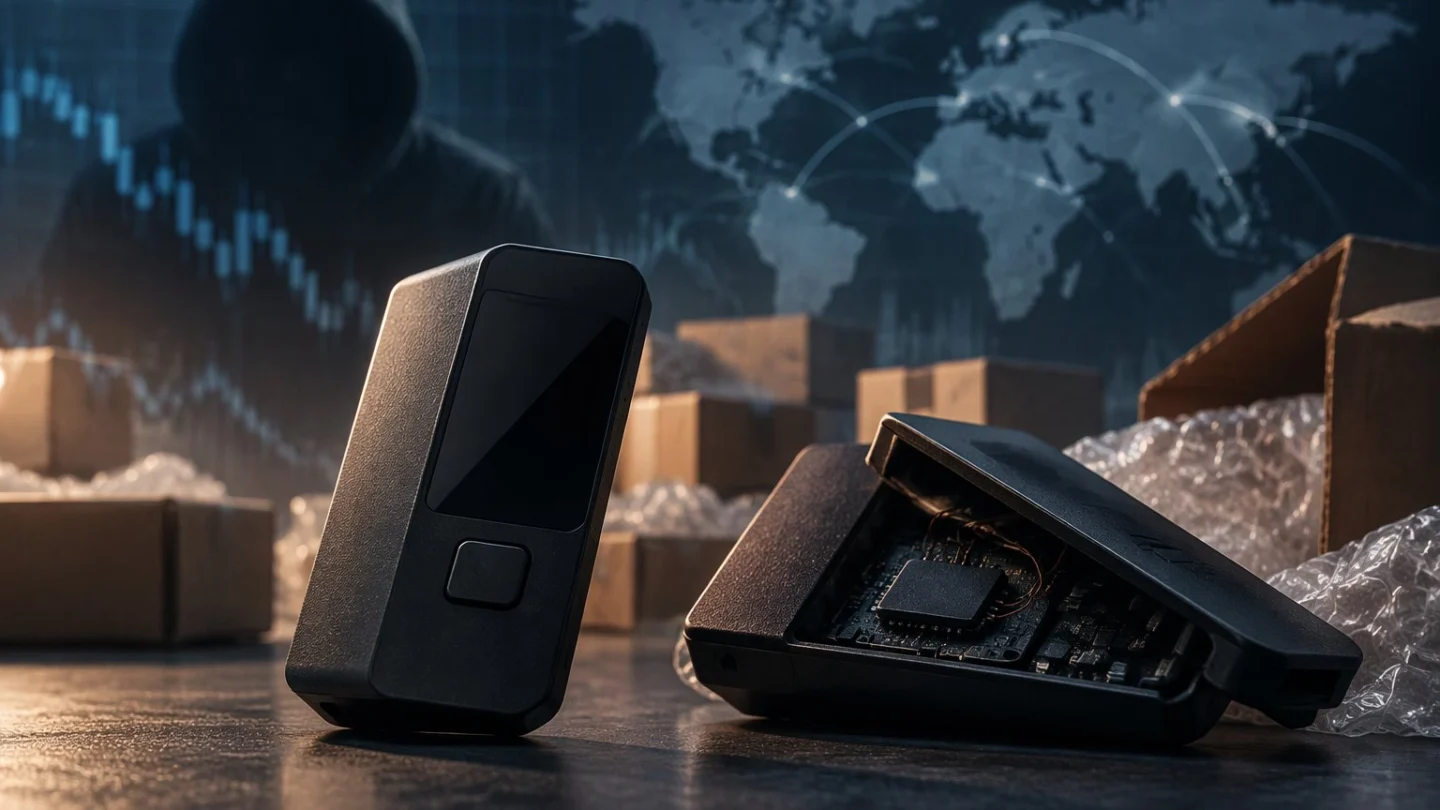
It is an additional circuit board, wedged in between the Safe 5’s main board and its screen.
It only listens. It copies whatever the screen shows, including what the owner types on the device, and does not touch the device firmware or the Secure Element, the chip that guards the keys.
When recovery words appear, it stores them. That covers the words shown when a new backup is created and the words typed when an old wallet is restored. A passphrase shown on screen is captured too.
It encrypts what it takes and transmits it over a cellular connection to a server the attackers control. If it cannot connect, it waits and tries again.
Trezor says it works the same way as the implants found in Ledger devices, adapted to the Safe 5’s display. Trezor has not said who fitted the implants.
The record so far
- 9 Oct. Trezor removes CryptoBilis as a reseller as Ledger investigates losses among buyers from the same seller.
- 28 Oct. A customer reports an implant in a Safe 5 bought via Tokopedia.
- 30 Oct. Trezor publishes its first warning and tells CryptoBilis buyers to move funds.
- 11 Nov. Firmware 2.13.1 ships.
- 12 Nov. Trezor confirms three implanted devices. Forty-eight CryptoBilis customers have come forward so far, and checks on devices from its other resellers in the region found no tampering.
Trezor says it has found no implant in any other model, or in a device from any other seller.
Forty-eight buyers have answered. How many CryptoBilis wallets are still in drawers, unchecked?
Protect yourself
- If you bought a Trezor from CryptoBilis, move your funds to a fresh wallet with a newly generated recovery phrase. Restoring the old phrase elsewhere does not help, which is why the recovery phrase is the master key.
- Update any Trezor Safe 5 to firmware 2.13.1 or later.
- CryptoBilis buyers from March 2026 onwards can get a replacement. Keep the old device and contact Trezor Support.
- If a device looks tampered with, do not set it up or use it. Trezor asks owners to keep it and report it to support.
- Expect fake “replacement” and “refund” offers. Trezor says it will never ask for your recovery phrase.
Trezor is working with SEAL 911, the Security Alliance’s emergency team, and says it will date each new finding at the top of its post. In Asia the pattern has a precedent: tampered Ledger wallets from local shops cost two Singapore buyers about S$3.5 million, police said in October.
Two brands. One seller. Three boxes opened so far.
If the seal cannot tell you, and the screen cannot tell you, who checks the inside of a wallet before it reaches a buyer?
Corrections and new evidence: [email protected]
This article is for information only and is not investment advice.