

What is DeFi? Decentralized Finance Explained
DeFi rebuilds traditional financial services — lending, trading, savings — as code that anyone can use without a bank in the middle. Here's what it is, what works, and where the real risks are.
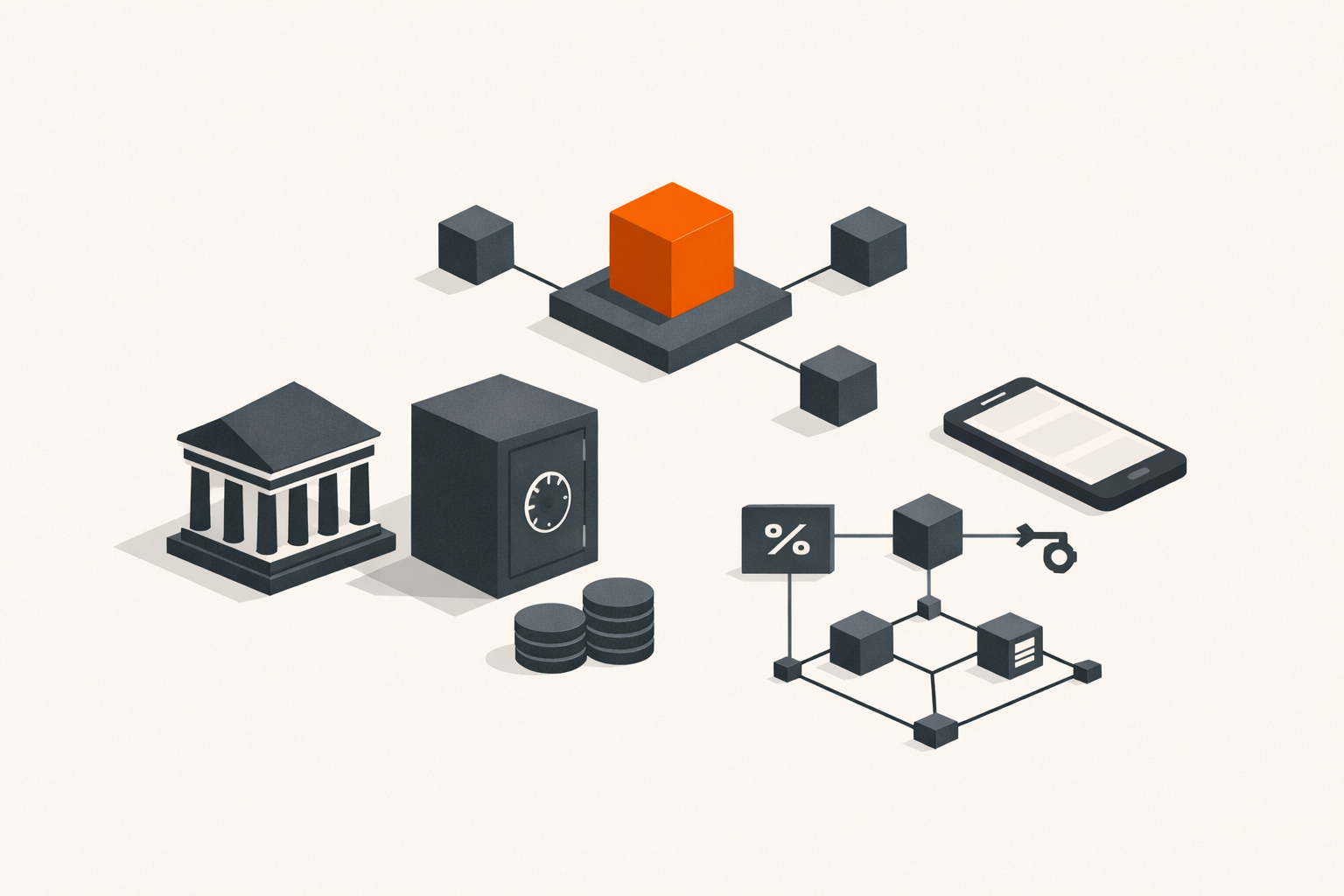
Decentralized Finance — DeFi for short — is shorthand for a class of financial applications built on public blockchains. Instead of a bank or broker holding your money and executing transactions on your behalf, smart contracts do the same work autonomously. The result is finance that's open, programmable, and accessible to anyone with an internet connection — but also rough around the edges and full of pitfalls.
The Core Idea
Take any financial service: lending, borrowing, trading, savings, insurance. In traditional finance, the institution holds your assets and executes the service. In DeFi, the assets stay in your wallet (or in a smart contract you can withdraw from), and the service is rendered by code anyone can read and audit.
Three things make this possible: public blockchains as the settlement layer, smart contracts as the logic layer, and tokens as the asset layer. Together they let you do most of what a bank does, with no bank involved.
The Major DeFi Categories
Decentralized Exchanges (DEXs)
Platforms like Uniswap and Curve let you swap one token for another by transacting directly with a liquidity pool — not an order book. You always trade against pooled assets at an algorithmic price. Anyone can become a liquidity provider and earn fees.
Lending Protocols
Aave, Compound, and Morpho let you deposit assets to earn interest, or borrow against deposited collateral. Borrowing is overcollateralized — you might post $1,000 in ETH to borrow $700 in stablecoins — which makes the system robust without needing credit checks.
Stablecoins
USDC, USDT, and DAI are tokens designed to hold a $1 peg. They're the unit of account inside DeFi: most lending, trading, and savings happens denominated in stablecoins, not in volatile crypto assets.
Yield Aggregators
Yearn, Pendle, and similar tools route deposits across DeFi protocols to chase the highest risk-adjusted yield, automating what a treasury manager would do manually.
What's Actually Useful
The most durable DeFi use cases are the boring ones: efficient stablecoin transfers, transparent lending markets, and cross-border payments that settle in minutes for cents. The flashy stuff — high-yield farms, leveraged protocols, exotic structured products — has a much higher failure rate.
If a DeFi protocol is offering yield that's 10x higher than US Treasuries, you should assume the difference is being paid in risk you can't easily price.
The Real Risks
Smart Contract Bugs
Code can have flaws. The history of DeFi includes hundreds of millions of dollars lost to bugs in code that had been audited multiple times. Even mature protocols carry residual risk.
Oracle Failures
Many DeFi protocols rely on external price feeds (oracles) to value collateral. When oracles fail or get manipulated, the protocols built on them break in expensive ways.
Stablecoin De-Pegs
"Stable" doesn't mean guaranteed. Algorithmic stablecoins have failed catastrophically (TerraUSD), and even fiat-backed stablecoins have briefly traded below peg in liquidity crunches.
User Error
The single largest cause of DeFi loss isn't hacks — it's users approving malicious transactions or sending tokens to wrong addresses. There's no customer service line.
How to Start Carefully
Begin with a tiny amount on a major protocol (Aave, Uniswap, Compound) on a Layer-2 (Arbitrum, Base) where fees are low. Treat the first month as tuition. Read every transaction your wallet asks you to sign — it should match exactly what the dApp says it's doing. If anything looks unfamiliar, reject it.