How to Buy Bitcoin: A Step-by-Step Guide for Beginners
Buying your first Bitcoin sounds intimidating, but the process has matured. Here's a practical, modern walkthrough — choosing an exchange, verifying your identity, placing the order, and moving it to a wallet you control.
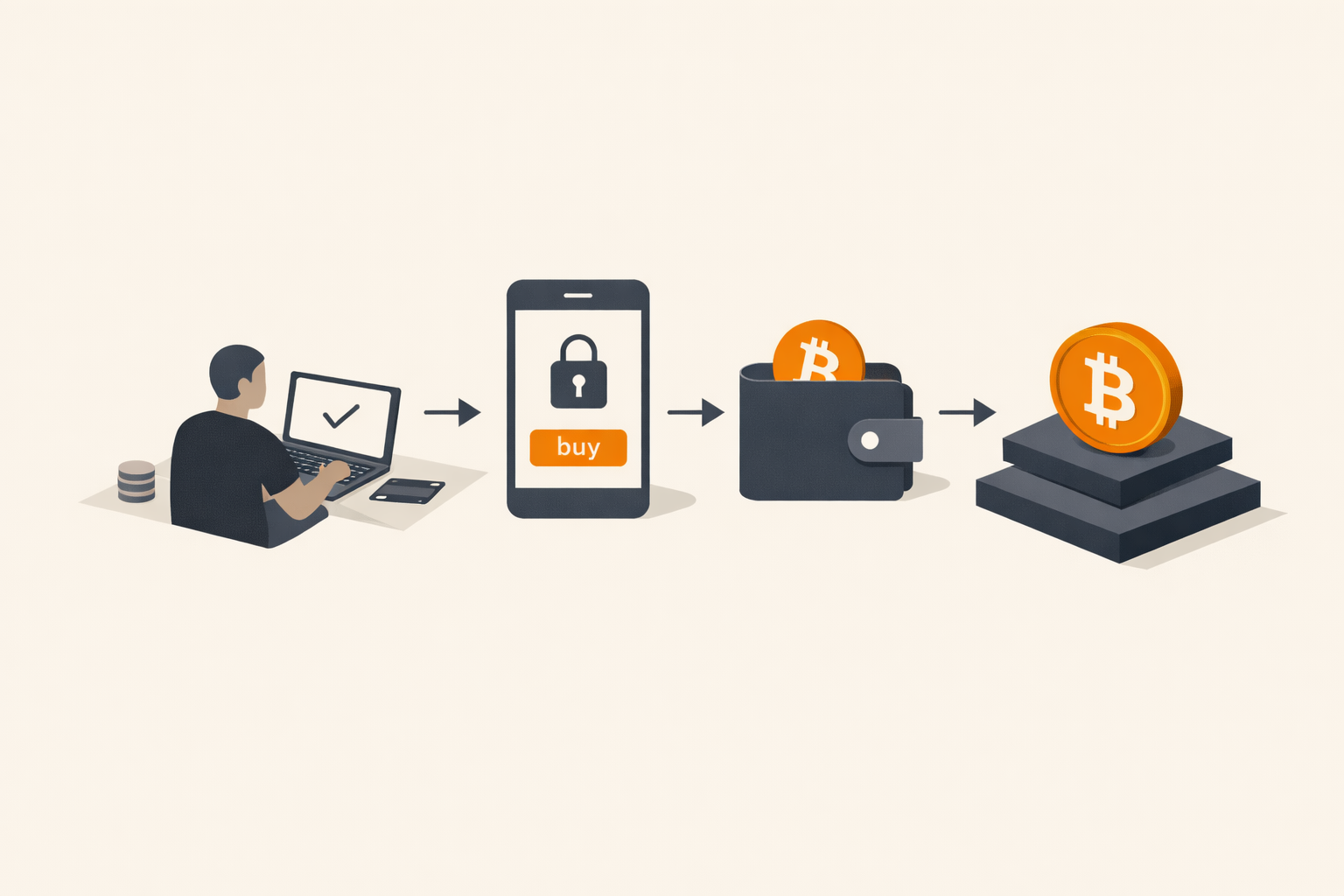
If you've decided to buy Bitcoin, the good news is that the process today is closer to opening a brokerage account than to the early-2010s wild west. The bad news is that the choices you make in the first hour shape your security for years. This guide walks through buying Bitcoin properly the first time.
Step 1: Pick a Reputable Exchange
An exchange is where you convert dollars (or your local currency) into Bitcoin. You want one that's licensed in your jurisdiction, has a long track record, and publishes proof of reserves.
- Coinbase — beginner-friendly, US-licensed, slightly higher fees
- Kraken — strong security history, lower fees, available in most countries
- Gemini — regulated in NY, good for taxable accounts
- Strike or Cash App — simplest mobile-first options for small amounts
What to Avoid
Skip any exchange you've only seen advertised on social media. Avoid platforms offering "guaranteed yield" — those are usually unsecured loans dressed up as products. And avoid exchanges that don't publish proof of reserves after the FTX collapse made that table-stakes.
Step 2: Complete KYC Verification
Regulated exchanges require Know-Your-Customer (KYC) verification: government ID, a selfie, and sometimes proof of address. This isn't optional. Submit clear photos and use accurate information; mismatches cause weeks of back-and-forth.
Step 3: Fund Your Account
Most exchanges accept bank transfer (ACH/SEPA), debit card, or wire transfer. Bank transfer is cheapest but takes 1–3 days. Card purchases are instant but charge 2–4% in fees. For a first purchase under $1,000, the convenience of card may be worth it.
Step 4: Place the Order
You'll see two main order types:
- Market order — buy at the current price, executes instantly. Easiest for beginners.
- Limit order — set the price you're willing to pay; the order fills only at or below that. Better if you're patient.
You don't need to buy a whole Bitcoin. Bitcoin is divisible to 8 decimals (0.00000001 BTC = 1 satoshi). A purchase of $50 gives you whatever fraction the current price implies.
Step 5: Move It to a Wallet You Control
This is the step most beginners skip and most regret. Bitcoin held on an exchange is technically the exchange's — they hold the keys. If the exchange fails (and several have), recovery can take years or never happen.
"Not your keys, not your coins" is the oldest rule in crypto and the most often broken. For anything you intend to hold longer than a week, move it off the exchange.
For small amounts, a reputable mobile wallet (BlueWallet, Muun) is fine. For meaningful amounts, a hardware wallet (Ledger, Trezor, Coldcard) is the standard.
Step 6: Back Up Your Seed Phrase
When you set up a wallet, you'll be given a 12 or 24-word recovery phrase. Write it down on paper, store it somewhere safe (or two places), and never digitize it. No screenshots, no cloud notes, no password managers.
What Comes Next
Buy a small amount first. Move it to your wallet. Send a test transaction back to the exchange. The friction teaches you the workflow before stakes are high. After that, dollar-cost averaging — buying a fixed amount on a schedule — outperforms most attempts at timing the market.