


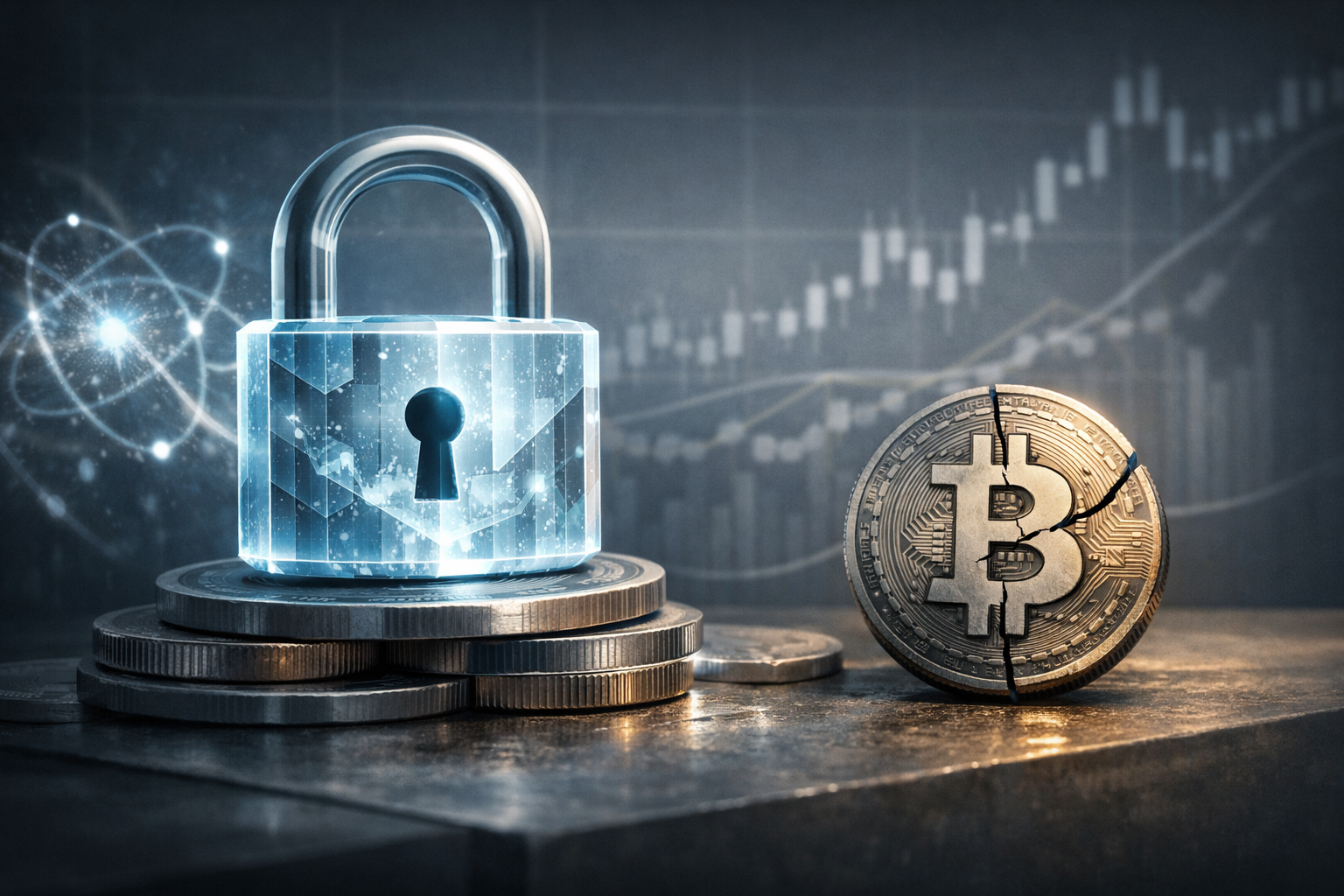
The quantum computing threat to cryptocurrency has moved from theoretical to urgent, minting its first market winners in the process. Post-quantum cryptography (PQC) projects have surged up to 50% as investors position for what experts call 'Q-Day'—when quantum computers become powerful enough to break current blockchain encryption.
This surge follows a convergence of milestone developments: quantum cryptography pioneers winning the prestigious Turing Award, NIST selecting quantum-resistant encryption algorithms, and stark warnings that Bitcoin's security could be compromised within five years.
CRYSTALS-Kyber, CRYSTALS-Dilithium, FALCON, SPHINCS+
The National Institute of Standards and Technology (NIST) recently concluded its six-year competition to identify quantum-resistant cryptographic algorithms. The winners include CRYSTALS-Kyber for general encryption and three algorithms for digital signatures: CRYSTALS-Dilithium, FALCON, and SPHINCS+. These lattice-based and hash-based designs are specifically engineered to withstand attacks from quantum computers.
"An important milestone in securing sensitive data against future quantum cyberattacks," declared Commerce Secretary Gina Raimondo. Final standards are expected within two years, setting the framework for public networks, banking systems, and blockchain applications.
Bitcoin's Ticking Clock
Crypto expert Charles Edwards warns that quantum computers could break Bitcoin's encryption within five years, with vulnerable addresses—particularly older pay-to-public-key-hash (p2pkh) addresses with exposed public keys—at greatest risk. "My biggest fear is everyone talks risks but acts too late," Edwards said in a recent podcast.
The timeline is driven by aggressive hardware development. IBM projects deploying over 100,000 physical qubits by 2029, while IonQ targets 8,000 logical qubits—sufficient to execute Shor's algorithm, which can crack the elliptic curve cryptography (ECC) securing Bitcoin and most blockchains. Bitcoin Improvement Proposal 360 (BIP360) has been proposed to establish migration pathways to quantum-resistant signatures.
Quantum Pioneers Recognized
The urgency gained additional context on March 18, 2026, when Charles Bennett and Gilles Brassard received the A.M. Turing Award—computing's highest honor—with a $1 million prize for establishing the foundations of quantum information science. Their 1984 BB84 protocol for quantum key distribution (QKD) pioneered methods for detecting eavesdropping through quantum mechanics principles.
The 2025 Nobel Prize in Physics further highlighted quantum computing's advance, recognizing John Clarke, Michel Devoret, and John Martinis for discovering macroscopic quantum mechanical tunnelling in electric circuits—foundational work that enabled scalable quantum processors.
Market Implications
The 50% rally in quantum-resistant projects reflects investor recognition that the threat is real and imminent. With a $2.5 trillion crypto market at stake, early movers adopting NIST's approved algorithms are commanding premium valuations.
However, skeptics urge caution. University of Maryland cryptographer Ian Miers suggests quantum timelines may be "hyped for funding," arguing practical quantum threats remain years away. Nonetheless, the accelerating U.S.-China quantum race and potential executive orders around quantum supremacy are keeping pressure on the industry to act.
For crypto holders, the message is clear: migration to quantum-safe wallets and support for PQC-enabled blockchains is no longer optional. The quantum debate has moved from academic circles to market reality, and the winners are already emerging.