


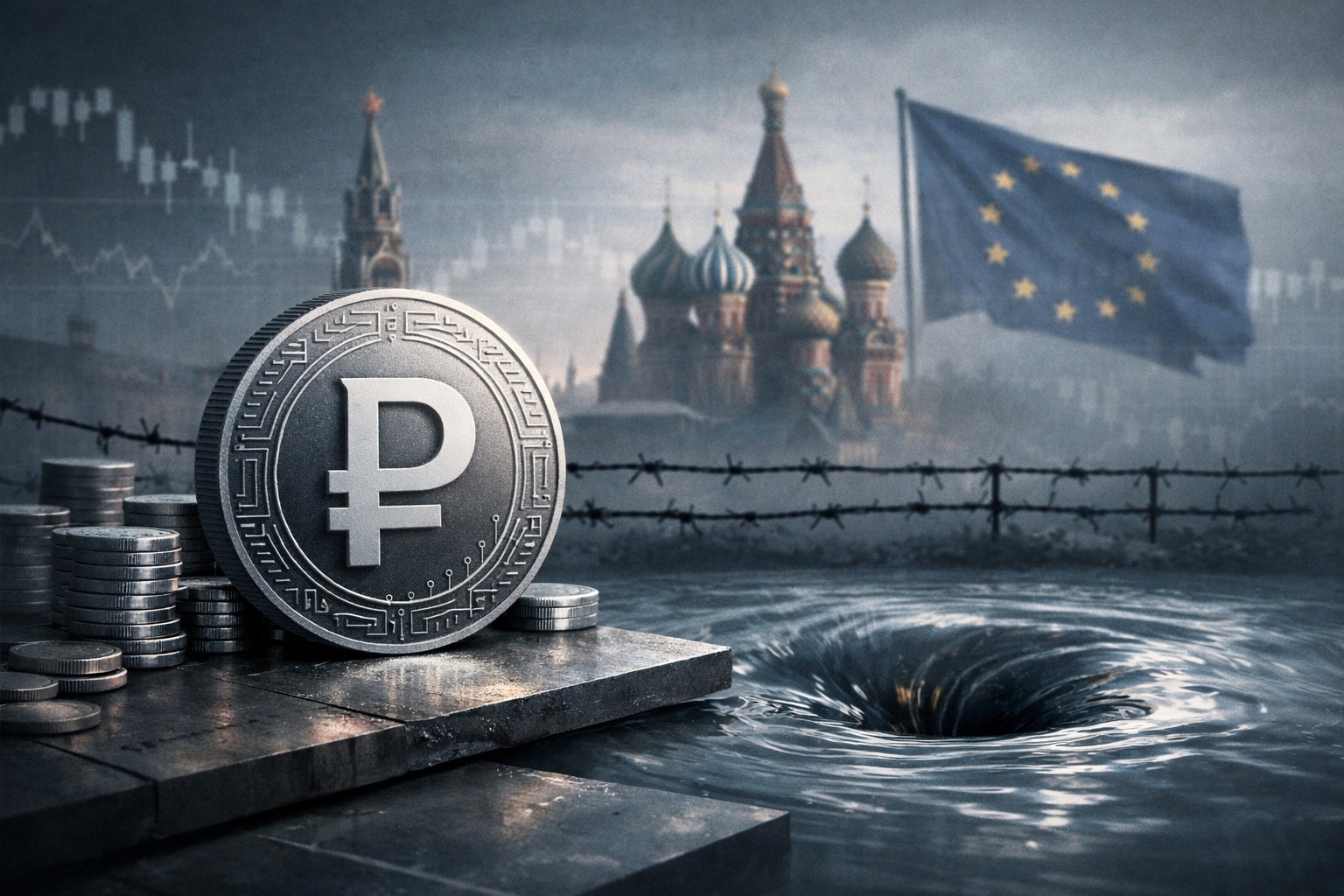
Russia's Central Bank is accelerating its digital ruble pilot program, launched in January 2026, to reshape domestic payments with unprecedented state control over transactions. The initiative comes as Western sanctions intensify, prompting EU foreign policy chief Kaja Kallas to pledge in February 2026 that the bloc will block the digital ruble from international payment systems.
The centralized digital currency operates on a CBR-managed platform and offers features no physical cash can match: transaction reversals, automatic tax collection, and spending restrictions. However, the rollout threatens to drain 4 trillion rubles ($40 billion) in liquidity from Russia's commercial banking sector.
Programmable Money Meets Social Control
The digital ruble pilot currently targets social payments like maternity capital, using programmable features to prevent misuse. Authorities can restrict these funds from being spent on gambling, alcohol purchases, or converted through unrecognized merchant codes—schemes that previously drained billions from benefit programs.
The Central Bank can annul what it deems "incorrect" transactions and is discussing expanding restrictions to block specific types of purchases entirely. Unlike decentralized cryptocurrencies such as Bitcoin, the digital ruble functions as a liability of the Central Bank of Russia on a centralized platform, giving authorities complete visibility into every transaction.
This development follows Russia's 2022 loss of access to $300 billion in frozen reserves and SWIFT banking networks after the Ukraine invasion, accelerating the search for sanctions-resistant payment alternatives. The digital ruble positions Russia to link with BRICS partners' digital currencies—China's e-CNY and India's digital rupee—potentially bypassing dollar-dominated systems for direct trade settlements.
Banking Sector Faces Existential Threat
Commercial banks view the full rollout with alarm. As depositors shift funds to Central Bank digital wallets, banks could lose 4 trillion rubles in liquidity, severely constraining their lending capacity and profitability. This echoes concerns voiced during the European Central Bank's digital euro discussions, where financial institutions have lobbied for tiered systems to preserve their intermediary roles.
Critics note the privacy trade-offs: every digital ruble transaction becomes traceable, eliminating cash's anonymity. The system also offers no cashback or incentives comparable to private payment apps, potentially limiting voluntary adoption beyond mandated government payments.
Global CBDC Race Accelerates
Russia's experiment unfolds amid a worldwide shift toward central bank digital currencies. Nearly 100 countries are now exploring CBDC options, seeking to modernize payments and maintain monetary sovereignty as transactions migrate to cryptocurrency platforms.
China's digital yuan already handles billions in transactions through extensive pilots, while the ECB continues testing a digital euro. Russia's version stands out for its explicit control mechanisms, including the ability to block inheritances to "unreliable" individuals and enforce real-time tax collection.
Meanwhile, cryptocurrencies continue serving as sanctions evasion tools. Recent reporting revealed Chinese firms supplying drone parts to Russia's military via USDT (Tether) payments, with one wallet handling 4.2 million USDT despite Beijing's export restrictions. North Korea's Lazarus Group stole $1.46 billion in Ethereum from Bybit exchange in February 2026, converting it to 13,562 BTC and vaulting Pyongyang to the third-largest government Bitcoin holder globally, behind the U.S. Strategic Bitcoin Reserve (198,109 BTC, $16.71 billion) and the UK (61,245 BTC, $5.17 billion).
International Resistance Mounts
The EU's 19th sanctions package, implemented after April 25, 2026, banned Russian LNG imports, crypto services for Russian nationals, and ruble-backed stablecoins like A7A5. Switzerland has enacted similar restrictions. These measures signal coordinated efforts to prevent Russia from using digital currency innovations to circumvent financial isolation.
As the digital ruble pilot expands beyond its initial social payment focus, the outcome will test whether centralized digital currencies can deliver on promises of enhanced control without triggering capital flight to decentralized alternatives like Bitcoin or traditional safe havens like gold. For Russia's commercial banks and the broader financial system, the stakes couldn't be higher.